#1 Overall Winner
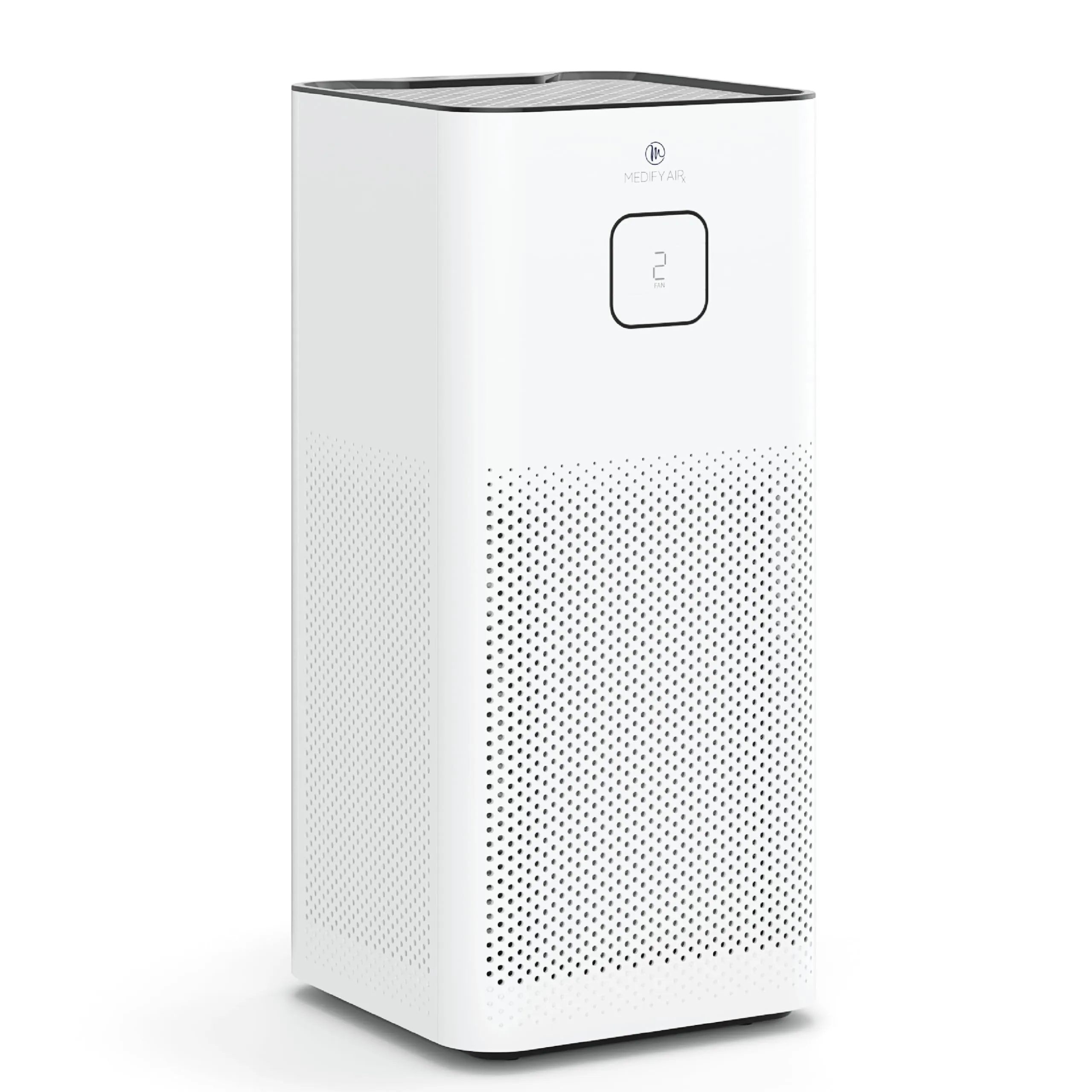
Medify MA-50 Air Purifier V3.0
- Published CADR of 598 and stated coverage up to 2,640 square feet in one hour.
Comparison
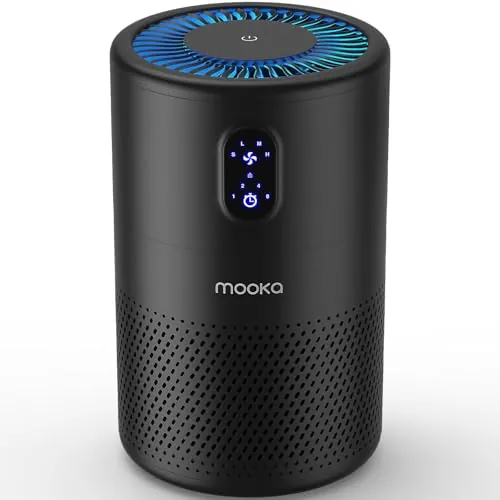
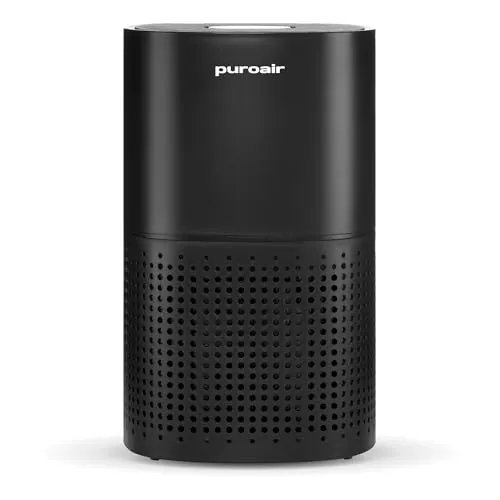
The Medify MA-50 and MOOKA KJ190 are large-room HEPA air purifiers for dust, pollen, pet dander, smoke, and odors. Medify emphasizes documented airflow capacity and fine-particle filtration, while MOOKA focuses on affordability, air-quality monitoring, auto mode, and washable pre-filter care. Choose based on whether you need the Medify’s published CADR and larger stated coverage or the MOOKA’s lower cost and more automated everyday controls.
#1 Overall Winner
Contender
Choose the Medify MA-50 for very large spaces where a published CADR, high stated coverage, and listed lifetime warranty outweigh the higher purchase and filter costs. Choose the MOOKA KJ190 for a bedroom or everyday home use when you want sensor-based auto mode, easier pre-filter care, compact portability, and lower upfront cost.
Overall winner
Depends on your needs
| Feature | Medify MA-50 Air Purifier V3.0 | MOOKA KJ190 Air Purifier | Winner |
|---|---|---|---|
| Listed price | $299.99 | $67.59 | MOOKA KJ190 Air Purifier |
| Stated coverage | Up to 2,640 ft² in 1 hour | Up to 2,200 ft² in 1 hour | Medify MA-50 Air Purifier V3.0 |
| Published CADR | 598 | Not provided | Medify MA-50 Air Purifier V3.0 |
| Filtration specification | H13; 0.1 microns listed | HEPA; 0.3 microns listed | Medify MA-50 Air Purifier V3.0 |
| Air-quality monitoring | Not listed | PM2.5 display and auto mode | MOOKA KJ190 Air Purifier |
| Power rating | 70 watts | 22 watts | MOOKA KJ190 Air Purifier |
| Sleep-mode noise | 22 dB minimum listed | 20 dB listed | MOOKA KJ190 Air Purifier |
| Filter care | Replace about every 2,500 hours | Washable pre-filter; 2,000-hour reminder | MOOKA KJ190 Air Purifier |
| Controls | Touch panel, timer, sleep mode | Touch controls, timer, auto mode, PM2.5 display | MOOKA KJ190 Air Purifier |
| Portability | 20 x 10 x 18 in listed | 6.7 lb; 6.1 x 12.2 x 15.75 in | MOOKA KJ190 Air Purifier |
| Warranty and support | Lifetime warranty listed | 60-day return, 2-year exchange, lifetime technical support | Depends |
| Certifications | CARB, ETL, Energy Star | CARB, ETL, DOE | Depends |
For everyday home use, both units address common airborne concerns such as dust, pollen, pet dander, smoke, and odors. The Medify MA-50 suits a fixed position in a larger shared space, provided the surrounding vents and rear cord have adequate clearance. The MOOKA KJ190 is more flexible for moving between a bedroom, office, or smaller living area thanks to its compact, lightweight design. Its PM2.5 display and auto mode also make it more hands-off when air conditions change during cooking or daily activity.
Both purifiers can support home hygiene by filtering airborne dust, pollen, and pet dander, but they do not replace vacuuming, surface cleaning, or source control. Medify’s published CADR and stated large-space coverage favor open living and dining areas where airborne particles circulate widely. MOOKA’s washable pre-filter is useful in pet homes because it can be cleaned as part of regular upkeep. Buyer feedback for both models mentions reduced dust and fresher-smelling rooms.
Neither purifier controls temperature or humidity, but both can contribute to perceived room comfort by reducing airborne particles and odors. Medify buyers frequently mention allergy and sinus comfort, and its low setting is described as suitable for overnight use by some reviewers. MOOKA adds a PM2.5 display, auto mode, and a lights-off sleep setting, which can make bedroom operation less intrusive. Noise at stronger fan settings is the key comfort limitation for both models.
The Medify MA-50 has the stronger documented air-cleaning case. It provides a CADR of 598, a higher stated one-hour coverage figure, and a stated H13 capture threshold of 0.1 microns. Buyer feedback also points to useful dust, odor, and allergy relief. The MOOKA KJ190 has similarly favorable reports for dust, pet-related odors, smoke, and fresher air, and its sensor can respond automatically to changing conditions. However, its 2,200-square-foot claim cannot be compared directly with Medify because no CADR is supplied. For a very large open room, Medify has the clearer evidence base.
Both models have broadly positive buyer feedback, but their reliability evidence differs. Medify has a review from an owner who used an MA-50 for years before an LED failed; the purifier continued operating, and the company reportedly arranged a replacement. This supports its listed lifetime warranty, though it does not eliminate the possibility of faults. MOOKA reviews describe strong initial performance and effective auto behavior, but the supplied material has less long-term ownership evidence. For longer-term reassurance, Medify has the advantage; for day-one usability, both appear dependable.
Medify has a modest edge for air-cleaning performance because it combines a published CADR, high stated coverage, and a 0.1-micron H13 filtration specification. Its buyers often report visible filter dust buildup and reduced allergy-related symptoms. MOOKA also performs well in buyer reports, particularly for dust, pet hair, musty smells, and smoke. Its washable pre-filter is helpful for larger debris, but its supplied 0.3-micron specification and absent CADR make direct filtration and airflow comparisons less certain.
These are air-cleaning products rather than climate-control appliances, so neither heats, cools, or manages humidity. Their climate-comfort role is limited to improving perceived indoor air freshness by filtering stated contaminants. Medify offers more confidence for a large room based on its published CADR and coverage information. MOOKA’s PM2.5 sensor and auto mode provide useful responsiveness when cooking or smoke changes particle levels. Use either alongside, not instead of, ventilation and temperature control.
Both products list child-lock functions, which can help prevent accidental control changes in homes with children or pets. Medify lists CARB and ETL certification, while MOOKA lists CARB, ETL, and DOE certification and states that it has no ozone release or UV light. MOOKA’s listing specifically instructs users to remove the protective plastic bag from the filter before operation. For either model, use the stated AC power source, keep intake and outlet areas clear, and follow the supplied filter and placement instructions. No additional safety performance should be inferred beyond the provided information.
Both models can improve day-to-day comfort where dust, pollen, odors, or pet dander affect a room. Medify is the more convincing choice for maintaining air circulation in a large common area, while MOOKA is more convenient for a bedroom due to its sleep setting, lights-off operation, compactness, and automatic response. Reviewers of both models report fresher-feeling rooms and easier breathing, but these are individual experiences rather than a guarantee of health outcomes.
Both models use touch controls and provide familiar timer, sleep, and filter-reminder functions. MOOKA is easier for a first-time owner because it is compact, buyers commonly describe setup and cleaning as straightforward, and auto mode can reduce manual fan adjustments. The washable pre-filter also simplifies routine care. Medify is still uncomplicated, but review feedback identifies more placement constraints because its intake areas and rear cord need clearance. Its panel-light behavior can also be a minor bedroom-use annoyance.
The Medify MA-50 has a taller, deeper cabinet intended for a more permanent floor position. Its top-mounted controls and air inlets on multiple sides mean it should not be treated as a side table or pushed tightly against a wall. The MOOKA KJ190 is markedly more compact and listed at 6.7 pounds, making it easier to reposition. Its digital air-quality display also gives immediate status feedback. For placement flexibility and smaller rooms, MOOKA has the more practical design.
Medify is the better option where coverage is the priority. It states up to 2,640 square feet in one hour and 1,320 square feet in 30 minutes, supported by a published CADR of 598. MOOKA states coverage up to 2,200 square feet per hour, but the supplied listing has no CADR, so this claim is harder to evaluate against Medify. For a bedroom or a contained room, MOOKA may be sufficient; for a broad open-plan area, Medify is the safer comparison-led choice.
MOOKA uses less floor space and is easier to fit in a bedroom, apartment, or office. Its narrow 6.1-inch depth is particularly useful where furniture placement is tight. Medify’s larger cabinet can be worthwhile for a larger shared area, but it requires additional clearance around its air inlets and rear cord, reducing its effective space efficiency. Avoid placing either purifier behind furniture or in a tightly enclosed corner.
MOOKA lists 20 dB in sleep mode, marginally below Medify’s stated 22 dB minimum. Both receive mixed buyer feedback: low or sleep settings are commonly considered suitable for bedrooms, while higher fan speeds become more audible. MOOKA reviewers compare its stronger settings to a box fan, and Medify reviews also note that high-speed operation can stand out in a quiet room. Neither is ideal at maximum speed beside a light sleeper.
Neither product requires permanent installation: both are plug-in, freestanding purifiers. MOOKA is the simpler physical setup because buyers describe inserting the filter and starting the unit quickly, and its smaller body is easier to locate. Medify needs more deliberate placement because its vents and rear cord should not be obstructed or set directly against a wall. For either unit, remove any protective packaging from the filter before use and leave clear airflow around the cabinet.
Medify has positive evidence for product support, including a long-term owner who reported a replacement after an LED issue, but its physical design has practical constraints around vent and cord placement. MOOKA buyers generally describe it as a compact, easy-to-disassemble unit, with one reviewer comparing its build favorably with a pricier purifier. Neither listing provides extensive material or component-life detail. Medify’s listed lifetime warranty gives additional reassurance, while MOOKA’s long-term construction record is less established in the supplied information.
Medify has slightly stronger durability support because an MA-50 owner reported continued operation after a minor LED failure and responsive replacement service, and the listing includes a lifetime warranty. Its filters remain a recurring consumable that must be planned for. MOOKA’s washable pre-filter may protect the main filter and reduce routine wear from captured debris, but there is limited long-term durability evidence in the supplied reviews. Neither product provides detailed information on motor lifespan or replacement-part availability beyond filters.
MOOKA is easier to maintain. Its washable pre-filter can be cleaned, its filter reminder activates after 2,000 hours, and buyers often describe it as easy to take apart and clean. The main filter still requires replacement according to the manufacturer’s guidance. Medify has a filter-replacement indicator and lists a roughly 2,500-hour filter life, but reviewers repeatedly flag replacement filters as expensive. One international review also reported difficulty obtaining an original Medify filter, so local availability is worth confirming before purchase.
MOOKA is the clear portability choice. It is listed at 6.7 pounds with a compact 6.1 by 12.2 by 15.75-inch body, and buyers describe it as lightweight. Medify’s listed dimensions of 20 by 10 by 18 inches make it better suited to remaining in one large-room location. Its weight specification appears inconsistent, so the supplied dimensions are the more useful guide for moving and placement planning.
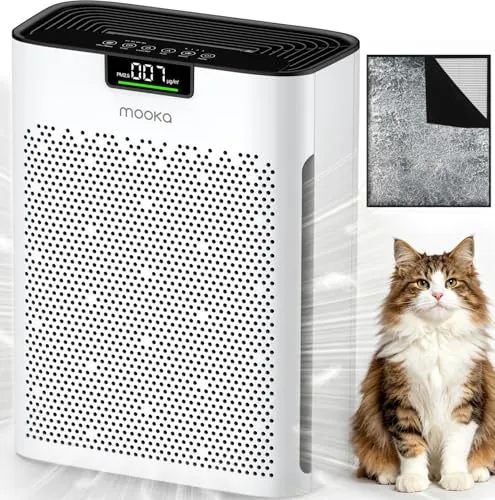
MOOKA has the broader convenience feature set. Alongside four speeds, timers, sleep mode, child lock, and a filter reminder, it includes a PM2.5 display, automatic fan adjustment, washable pre-filter, and aromatherapy pad. Medify supplies the essentials: four speeds, a zero-to-eight-hour timer, sleep mode, child lock, touch panel, and filter indicator. It does not list a particle sensor or auto mode. Medify’s advantage lies more in its published airflow and filtration specifications than in control automation.
MOOKA is the more automated purifier because its PM2.5 sensor, display, and auto mode can change fan speed according to surrounding air quality. This is useful for intermittent particle sources such as cooking or smoke, and several buyers describe the response as prompt. Medify includes a timer and sleep mode but does not list sensor-driven fan control. Choose MOOKA if hands-off operation matters more than Medify’s stronger published airflow data.
MOOKA has the advantage in stated power demand: its 22-watt rating is far below Medify’s 70 watts, and its listing states 0.63 kWh for 24 hours at maximum wind speed. The washable pre-filter may also extend the main filter’s service life when cleaned regularly. Medify’s Energy Star certification is a useful efficiency credential, but its higher wattage and more powerful published CADR reflect a different large-room role. Compare efficiency after considering the fan speed and room size you actually need.
MOOKA delivers better value for many households at its listed price of $67.59. It includes air-quality monitoring, auto mode, washable pre-filter care, sleep mode, and a low 22-watt rating, while buyers frequently describe it as good value. Medify costs $299.99, and its replacement filters are widely described as expensive. However, it adds a published CADR of 598, higher stated coverage, a finer listed filtration threshold, Energy Star certification, and a lifetime warranty. Medify can represent better value when those documented large-room credentials are necessary; otherwise, MOOKA is the more economical choice.
Medify has the stronger trust case in the supplied data because it lists CARB, ETL, and Energy Star certification alongside a lifetime warranty. A long-term owner also reports helpful customer service after a minor product fault. MOOKA lists CARB, ETL, and DOE certification, plus a 60-day return period, two-year exchange, and lifetime technical support. Its buyer feedback is favorable, but the supplied information contains less long-term support and durability evidence. Both brands require buyers to confirm replacement-filter availability in their location.
Both products have strong aggregate ratings and substantial review volumes, with frequent praise for dust reduction, odor management, simple controls, and improved perceived air quality. Medify has more reviews in the supplied data and especially positive comments about allergy comfort, filtration, and customer support. Its recurring criticisms are expensive filters, high-speed noise, and placement or light-control quirks. MOOKA buyers like its price, compact size, auto mode, washable pre-filter, and bedroom performance. Its main recurring criticism is stronger fan noise at higher settings, with one plug-compatibility complaint from an international buyer.
Medify lists a USA-registered lifetime warranty, and one review describes the company sending a replacement unit after an LED issue. MOOKA lists a 60-day no-reason return period, two-year exchange, and lifetime technical support. Medify offers longer stated product coverage, while MOOKA provides more detail about its early return and exchange terms. Confirm eligibility, local support access, and filter availability before ordering.
The MOOKA KJ190 wins for overall everyday value because it costs far less while providing useful air-quality monitoring, auto mode, compact portability, washable pre-filter care, and strong buyer satisfaction. Its main limitations are increased noise at higher speeds and less verifiable evidence behind its largest coverage claim.
The Medify MA-50 is the better large-room performance choice. Its published CADR, higher stated coverage, H13 0.1-micron specification, certifications, and lifetime warranty make it the more confidently documented option for a large shared space. Its main limitations are the premium price, costly filters, larger placement needs, and audible high-speed operation. Select Medify for documented capacity; select MOOKA for lower-cost automated convenience.

Overall winner
Depends on your needs
The Medify MA-50 is the stronger choice when a published CADR, larger stated coverage, H13 0.1-micron filtration claim, and listed lifetime warranty matter most. The MOOKA KJ190 is more compelling for buyers who want a much lower upfront price, PM2.5 monitoring, auto mode, and a washable pre-filter. The better fit depends on room size and priorities.
The Medify MA-50 is the clearer option for a large open area because it lists a CADR of 598 and coverage up to 2,640 square feet in one hour. MOOKA also claims large-room coverage, but the supplied listing does not provide CADR data to place that claim on the same basis. Placement and unobstructed airflow still matter for either purifier.
The MOOKA KJ190 is likely easier and less costly to maintain day to day because its pre-filter is washable and it has a filter reminder. The Medify MA-50 also provides a filter indicator, but its replacement filter is listed for roughly 2,500 hours and reviews commonly note the ongoing filter cost. Follow each manufacturer’s filter-care instructions.
MOOKA lists a 20 dB sleep mode with lights off, compared with Medify’s stated minimum of 22 dB, so it has a small specification advantage for bedtime use. In practice, both have mixed noise feedback at higher speeds. Reviews indicate that low settings are generally more suitable near sleepers, while stronger settings can sound more like a fan.
The MOOKA KJ190 includes a PM2.5 air-quality display and auto mode that adjusts fan speed according to detected conditions. The Medify MA-50 listing provides manual fan speeds, timer, sleep mode, child lock, and filter indicator, but does not list an air-quality sensor or auto mode. Choose MOOKA if sensor-led adjustment is a priority.
At the listed prices, the MOOKA KJ190 offers stronger value for shoppers focused on initial cost, compact size, auto mode, and washable pre-filter care. The Medify MA-50 costs more, but its published CADR, higher stated coverage, certifications, and listed lifetime warranty may justify the premium for users who need those documented specifications. Factor in filter availability and replacement costs.
Both products are positioned for pet-related dust, dander, and odors. Medify specifies H13 filtration and has buyer feedback describing reduced dust and allergy symptoms. MOOKA uses a larger front and dual-side intake design, a washable pre-filter, and activated carbon pellets; buyers often mention pet hair and odors. Neither replaces regular vacuuming or source cleaning.
Check the actual room size, where the purifier can sit with clear intake and outlet space, and the cost and availability of replacement filters. For the Medify, account for its larger footprint and recurring filter expense. For the MOOKA, assess whether its listed coverage suits your room without supplied CADR confirmation. Also consider higher-speed noise and local plug compatibility.
Check our rankings and expert guides to find the best home lifestyle products for your goals.