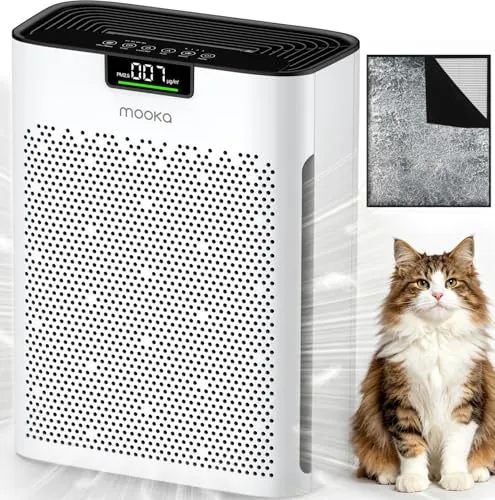
#1 Overall Winner
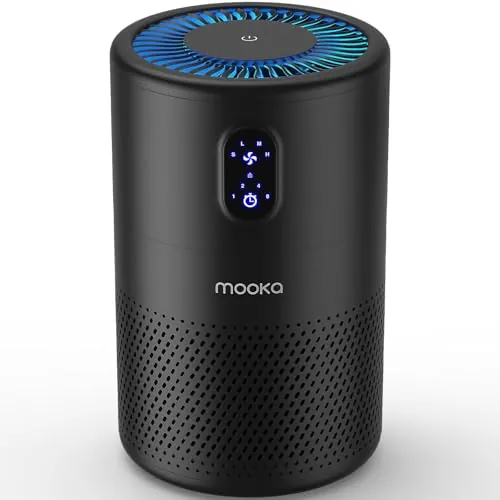
MOOKA B-D02L Air Purifier
- Listed coverage of up to 1,076 sq ft, with stated air-change guidance for smaller rooms.
Comparison
The MOOKA B-D02L and POMORON MJ002H are compact HEPA air purifiers aimed at dust, pollen, pet dander and everyday odor concerns. MOOKA focuses on straightforward filtration, lower power use and simple upkeep, while POMORON adds an ionizer, UV light, essential-oil tray and a longer timer. Both have favorable buyer feedback, but MOOKA has more consistent comments on odor removal and filter convenience.
#1 Overall Winner
Contender
Choose the MOOKA B-D02L for a simple, compact purifier with consistently positive feedback on dust, pet dander, odors and easy maintenance. Choose the POMORON MJ002H if you value a longer timer and its added ionizer, UV-light and essential-oil functions, while accepting more mixed feedback on odor removal and controls.
Overall winner
Depends on your needs
| Feature | MOOKA B-D02L Air Purifier | POMORON MJ002H Air Purifier | Winner |
|---|---|---|---|
| Primary filtration | Pre-filter, H13 True HEPA and activated carbon | Three-layer H13 filter with activated carbon | Tie |
| Listed maximum coverage | Up to 1,076 sq ft | Up to 1,250 sq ft | POMORON MJ002H Air Purifier |
| Room-size guidance | Lists air changes for 215 and 1,076 sq ft | Maximum coverage listed | MOOKA B-D02L Air Purifier |
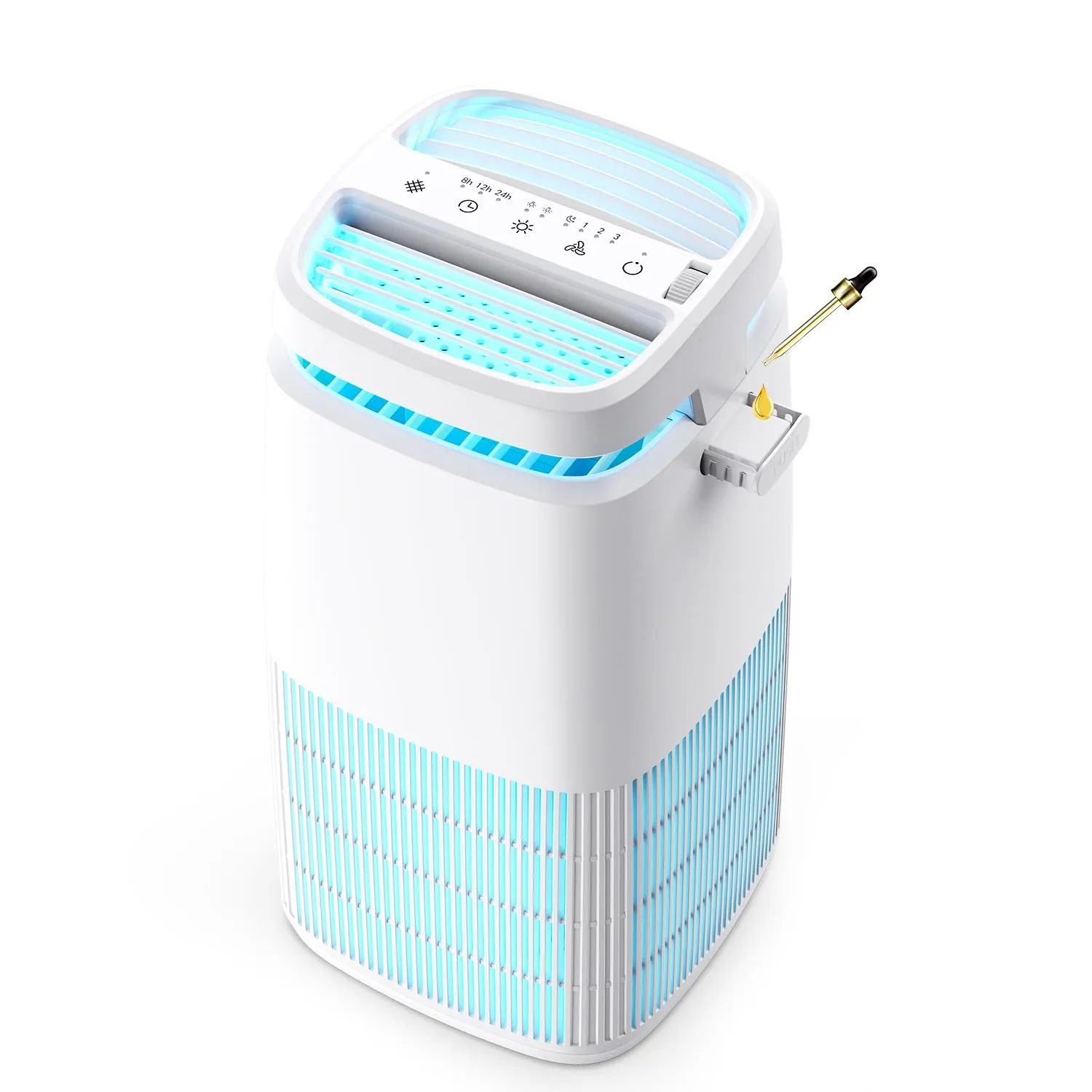
| Extra functions | Night light and child lock | Ionizer, UV light and essential-oil tray | POMORON MJ002H Air Purifier |
| Timers | 1, 2, 4 or 8 hours | 8, 12 or 24 hours | Depends |
| Fan modes | Sleep, Low, Medium, High | Four speeds | Tie |
| Listed noise level | 20 dB | 15 dB | POMORON MJ002H Air Purifier |
| Power draw | 13 watts | 17 watts | MOOKA B-D02L Air Purifier |
| Portability | 3.6 lb; 7.1 x 7.1 x 11.1 in | 3.5 lb; 6.34 x 6.34 x 11.81 in | Tie |
| Filter replacement | Replace every 3–6 months; buyers cite easy changes | Official MJ002H filters recommended | MOOKA B-D02L Air Purifier |
| Odor feedback | Generally positive for smoke and household odors | Mixed, especially for smoke odors | MOOKA B-D02L Air Purifier |
| Safety-related features | Child lock listed | FCC and UL certifications listed | Depends |
For everyday home use, MOOKA is the more uncomplicated option: place it in a bedroom, office, living area or pet zone, select a fan setting and replace the filter as needed. Its child lock may be useful in homes with children or pets. POMORON serves the same core role but adds functions that some households may enjoy, particularly its longer timer and essential-oil tray. The more practical choice depends on whether simple, consistent operation or extra modes is more important.
Both units are relevant to home hygiene because they are intended to filter airborne dust, pollen and pet dander, while their activated carbon filters are marketed for odors. MOOKA has more consistent buyer reports of reducing cooking, bathroom, smoke and musty smells. POMORON users also report dust collection and fresher rooms, but feedback on smoke odors is mixed. Neither replaces cleaning surfaces, source control or ventilation; they work as supplemental air-cleaning appliances.
Neither model controls room temperature or humidity, but both can support comfort by filtering particles and reducing stuffiness or household smells. MOOKA has stronger feedback for quiet bedtime operation and includes a controllable night light. POMORON can also work well in a bedroom on lower modes, though one buyer found its control lights too bright for sleep. For a calmer overnight setup, MOOKA has the clearer practical advantage.
Both purifiers have strong evidence of useful everyday air cleaning from their listed filter systems and customer feedback. MOOKA stands out for repeatedly reported dust reduction, fresher rooms, relief in pet households and more consistent odor control. It also supplies stated air-change guidance rather than only a maximum coverage figure. POMORON receives positive reports for airflow, dust capture and improved bedroom air, but its best-supported use appears to be small to medium rooms despite its larger listed coverage. Its smoke-odor results are inconsistent across reviews. For core purification confidence, MOOKA has the edge.
MOOKA has stronger overall buyer sentiment and several reports from households purchasing multiple units, which supports confidence in routine use. Still, one reviewer reported an idle high-pitched sound on a separately purchased unit. POMORON is often called effective and reliable in reviews, including one account after around 14 months, but touch-control responsiveness is a recurring concern in the supplied feedback. Neither product has enough long-term fault data here to make a definitive durability claim, but MOOKA has fewer practical usability warnings.
For airborne cleaning, both models have favorable reports of collecting dust and supporting pet homes. MOOKA has the more consistent pattern of reviews for dust, pet dander, pollen-related concerns and odor reduction, including smoke and musty spaces. POMORON is also praised for visible dust accumulation and better-feeling air, but its odor feedback varies. Based on the supplied evidence, MOOKA is the more dependable choice when dust and household odors are the central concerns.
These products are air purifiers rather than heating, cooling or humidity-control devices. Their contribution to room comfort is limited to air filtration and odor management. MOOKA is better supported by buyer feedback for reducing cooking and smoke-related smells, while POMORON has mixed results with smoke odors. Neither should be selected for temperature or humidity adjustment, as no such capability is listed.
MOOKA lists a child lock, which can help prevent accidental setting changes by children or pets. Its product information also instructs users to remove the filter packaging before operation and specifies AC power. POMORON lists FCC and UL certifications in the supplied specifications and uses AC power, but no child lock is listed. Both should be placed securely with unobstructed airflow and maintained with the correct replacement filter. The supplied information does not provide comparative testing on electrical, fire or other safety outcomes.
MOOKA has the stronger comfort case for sleep areas because buyers often describe quiet low-speed use, and its night light can be switched off. Its reported help with dust, odors and pet areas may also make regularly used rooms feel fresher. POMORON can provide similar benefits and adds an essential-oil tray, but reviewers do not consistently find its scent output strong. Its visible control lights may be a drawback for light-sensitive sleepers.
MOOKA is easier to recommend for uncomplicated daily use. Reviews describe simple operation and filter replacement, and its controls cover the core settings without added functions to manage. POMORON also has touch controls and a compact format, but one buyer reported difficulty getting the touch buttons to respond. Its official-filter recommendation and less effective reported oil-tray scent spread also make the added features less straightforward in practice.
MOOKA measures 7.1 by 7.1 by 11.1 inches, while POMORON is slightly narrower at 6.34 by 6.34 inches and a little taller at 11.81 inches. Both work well on a side table, counter or small floor area. MOOKA’s night light can be turned off, which is useful near a bed. POMORON’s extra oil tray adds a lifestyle feature, but one buyer reports persistent panel lights in sleep mode. MOOKA is more bedroom-focused; POMORON is more feature-focused.
POMORON lists the larger maximum coverage area at 1,250 sq ft, compared with MOOKA’s 1,076 sq ft. However, stated maximum coverage does not show how quickly either purifier refreshes a large room. MOOKA gives more usable context by listing six air changes per hour in 215 sq ft and one air change per hour in 1,076 sq ft. For a bedroom or office, either is a plausible compact choice; for a large open area, compare room size with the stated air-change guidance.
Both purifiers are well suited to small spaces because their footprints are close to 7 inches square. POMORON’s narrower base may be useful on a crowded side table or counter, while MOOKA’s slightly shorter height may fit more easily beneath shelving. Buyers describe both as compact and unobtrusive. The choice is more likely to come down to preferred controls and features than the small difference in physical footprint.
POMORON lists the lower noise figure, while MOOKA is also marketed as quiet and receives frequent praise for sleep-mode use. In buyer feedback, both are generally acceptable on low settings but can be more noticeable at higher airflow. POMORON’s upper speeds have been described as disruptive for calls or TV by some users. MOOKA has one report of a high-pitched idle sound, so individual-unit variation remains possible.
Neither purifier requires mounting, wiring or a complex installation process. Both are portable AC-powered units intended for placement in a room and use through onboard controls. MOOKA specifically notes that its power adapter is stored with the filter and that the filter’s plastic bag must be removed before use. POMORON likewise needs its supplied filter fitted and a suitable placement location with airflow around the unit.
Both are lightweight compact appliances, so neither is presented as a heavy-duty floor unit. MOOKA has generally positive feedback for its practical, modern form, but its supplied review set includes one unit with a high-pitched sound while idle. POMORON is praised for compactness and airflow, although one long-term review raises a touch-switch concern. There is not enough supplied evidence for a major construction-quality gap, but MOOKA has slightly more reassuring day-to-day feedback.
Long-term durability evidence is limited for both compact purifiers. MOOKA reviews include buyers using units for extended periods and replacing dirty filters, while POMORON has one favorable report after roughly 14 months. However, the reported MOOKA idle noise and POMORON touch-control issue show that individual-unit problems can occur. Filter condition and regular replacement will matter for both models. There is no supplied information on repairability, spare parts beyond filters or long-term motor life.
MOOKA is the easier-maintenance choice. It specifies a three- to six-month filter replacement interval based on environment and use, and buyers describe filter changes as taking very little time. POMORON includes one filter but recommends official MJ002H filters, and a buyer specifically notes replacement-filter convenience and cost as a downside. Both will need filter monitoring, but MOOKA has the clearer and more favorable maintenance experience in the supplied information.
Both models are highly portable. MOOKA weighs 3.6 pounds and POMORON weighs 3.5 pounds, so either can be moved between a bedroom, office, living area or pet space without difficulty. POMORON is marginally narrower, while MOOKA is slightly shorter. There is no listed handle or wheel system, but their low weight makes that less important for ordinary room-to-room use.
POMORON offers the wider feature set: an ionizer, UV light, essential-oil tray, four speeds and 8-, 12- and 24-hour timers. These functions may appeal to buyers who want more than basic filtration, though the supplied information does not independently verify additional performance from the ionizer or UV light. MOOKA has four modes and 1-, 2-, 4- and 8-hour timers, plus a child lock and switchable night light. Its features are fewer but directly useful for sleep spaces and simple daily operation.
Automation is limited on both models. MOOKA offers 1-, 2-, 4- and 8-hour timed shutoff, while POMORON offers longer 8-, 12- and 24-hour timers. Neither has listed sensors, scheduling through an app, smart routines or remote control. POMORON is better for a long unattended run; MOOKA is more flexible for shorter sessions.
MOOKA lists a 13-watt power draw, lower than POMORON’s listed 17 watts, which gives MOOKA a modest advantage for continuous use based on the available specifications. Both use timer settings that can prevent unnecessary runtime. Filter costs and replacement frequency also affect real ownership costs: MOOKA calls for replacement every three to six months depending on conditions, while POMORON recommends official replacement filters. No comparative energy-use testing is provided.
MOOKA costs less in the supplied listings and combines its lower purchase price with a lower listed wattage, strong buyer ratings and positive comments about affordable, easy-to-find replacement filters. That makes it the stronger value for buyers who primarily want dependable filtration for dust, pets and odors. POMORON costs more but adds an ionizer, UV light, essential-oil tray and a 24-hour timer. It can be better value only if those extras are useful to you, since its official-filter recommendation and mixed odor feedback reduce its practical advantage.
Both brands have substantial review volumes and favorable average ratings in the supplied listings, which provides useful buyer-feedback volume but does not establish broader brand reputation or support quality. MOOKA has a slightly larger review base and more consistently favorable comments on core use and filters. POMORON lists FCC and UL certifications, while MOOKA highlights customer service in its listing. Warranty terms, parts programs and verified support outcomes are not supplied for either brand.
Customer satisfaction is favorable for both products. MOOKA has a slightly higher average rating and more reviews, with repeated praise for quiet operation, compact size, simple controls, dust reduction and odor removal. A small number of comments mention higher-speed noise or an isolated high-pitched idle sound. POMORON buyers often praise its value, compact design, airflow and air-quality improvement, but reviews are more divided on smoke-odor removal, sleep-mode lights and touch-control reliability. Overall sentiment favors MOOKA for consistency.
The MOOKA B-D02L is the clearer overall winner. Its main strengths are strong reported performance against dust, pet dander and common household odors, a compact portable design, low listed power draw, child lock and an easier reported filter-replacement experience. Its main limitation is a relatively basic feature set, with no listed remote, app or long timer beyond eight hours.
The POMORON MJ002H is a credible alternative for feature-focused buyers. It lists a larger coverage figure and includes an ionizer, UV light, essential-oil tray and a 24-hour timer. However, mixed smoke-odor feedback, specific-filter recommendations and occasional touch-control complaints make it less consistently reassuring for core day-to-day use. For most households, choose MOOKA; choose POMORON when its extra functions genuinely matter.

Overall winner
Depends on your needs
The MOOKA B-D02L is the stronger all-round choice based on its more consistent buyer feedback for dust and odor reduction, simple maintenance and child lock. The POMORON MJ002H is a better fit for shoppers who specifically want its added ionizer, UV-light and essential-oil functions, plus a longer timer. Neither has listed app or remote control.
Either can suit a bedroom because both are compact and offer lower-speed settings that buyers generally find quiet. MOOKA is the safer choice for a dark sleeping environment because its night light can be turned off and buyers praise its sleep mode. A POMORON buyer reports that its blue control lights remain visible during sleep mode.
Both products list H13/HEPA filtration and activated carbon, and both receive favorable reports from pet owners. MOOKA has especially consistent review feedback for pet dander, dust and allergy-related use. POMORON buyers also report dust collection and improved air quality, but the clearest evidence in the supplied feedback favors MOOKA for routine pet-home use.
MOOKA lists a 20 dB noise level, while POMORON lists 15 dB, though listed figures should not be treated as identical real-room measurements. Buyers generally find both quiet on lower modes. Higher settings can be noticeable on either model, with POMORON reviewers specifically describing upper speeds as white-noise-like during calls or TV viewing.
POMORON offers the longer timer range, with 8-, 12- and 24-hour options. MOOKA offers 1-, 2-, 4- and 8-hour settings, which is useful for shorter scheduled runs. Choose POMORON if you want a full-day timed cycle; choose MOOKA if shorter shutdown intervals are more useful for your routine.
MOOKA has the more favorable maintenance feedback. Its listed replacement interval is every three to six months depending on conditions, and buyers describe changing the filter as quick and straightforward. POMORON includes one filter but recommends official MJ002H replacement filters; buyer feedback notes that this can be less convenient and add to ongoing costs.
The supplied reviews do not support a clear POMORON advantage for smoke odors. Some POMORON buyers report good odor reduction, while others say smoke smells remain. MOOKA feedback is more consistently positive about smoke, cooking, bathroom and musty odors. Results will still vary with room size, source strength, ventilation and filter condition.
No app, Wi-Fi, voice-assistant or smart-home compatibility is listed for either purifier. Both use on-unit touch or button controls and timers. Their automation is limited to timed shutoff and selectable fan modes, so they suit buyers who prefer a simple standalone appliance rather than connected monitoring or remote operation.
Check our rankings and expert guides to find the best home lifestyle products for your goals.