#1 Overall Winner
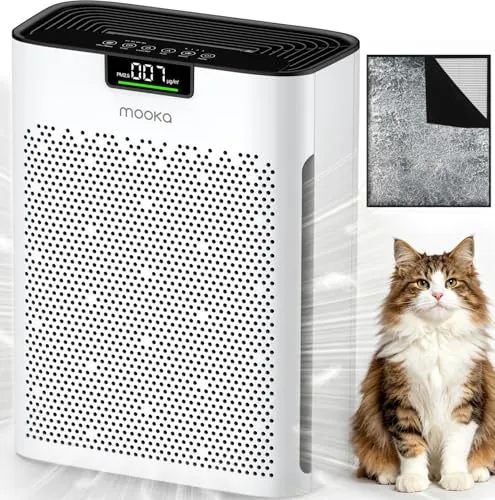
MOOKA KJ190 Air Purifier
- Listed coverage of up to 2,200 square feet per hour, though no CADR figure is provided.
Comparison
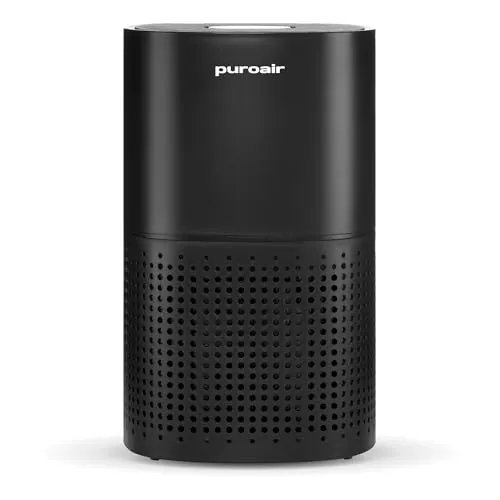
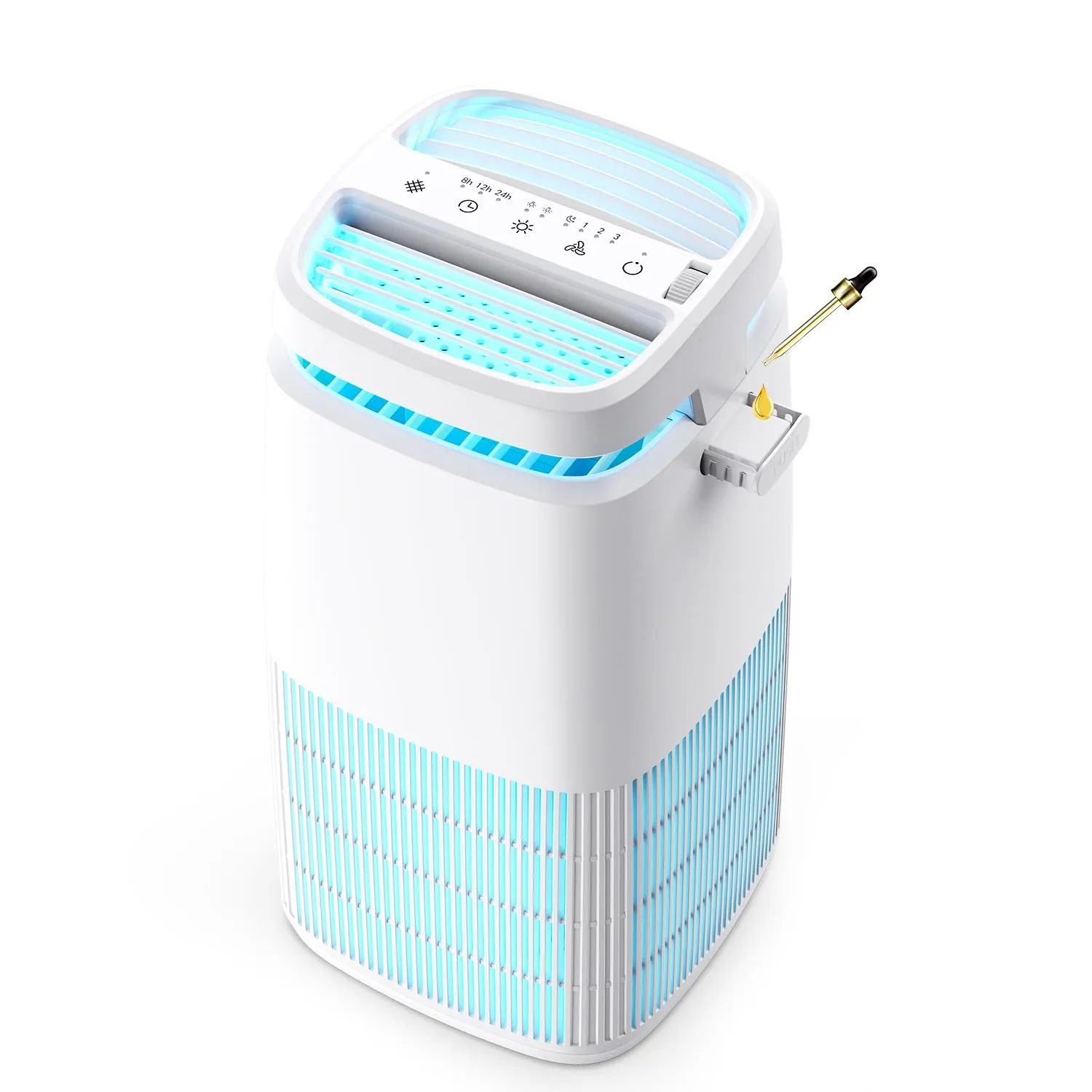
The MOOKA KJ190 and POMORON MJ002H are compact home air purifiers designed to address dust, pollen, pet dander, smoke, and everyday odors. MOOKA offers sensor-based auto mode, a washable pre-filter, and higher listed coverage, while POMORON costs less, takes up less space, and adds listed ionizer and UV functions.
#1 Overall Winner
Contender
Choose the MOOKA KJ190 for automatic air-quality response, a washable pre-filter, pet-focused use, and clearer support terms. Choose the POMORON MJ002H for a smaller room, limited space, and a lower upfront price. Both are reasonable for dust and pollen, but MOOKA provides the more practical everyday feature set.
Overall winner
Depends on your needs
| Feature | MOOKA KJ190 Air Purifier | POMORON MJ002H Air Purifier | Winner |
|---|---|---|---|
| Listed coverage | Up to 2,200 sq ft per hour; no CADR listed | 1,250 sq ft; no CADR listed | MOOKA KJ190 Air Purifier |
| Filtration approach | 3-stage system with washable pre-filter and HEPA filter | 3-layer H13 filter with activated carbon | Depends |
| Air-quality sensing | PM2.5 display and auto mode | Not listed | MOOKA KJ190 Air Purifier |
| Extra functions | Fragrance pad and child lock | Ionizer, UV light, and diffuser | Depends |
| Timer options | 2, 4, 6, or 8 hours | 8, 12, or 24 hours | Depends |
| Noise | 20 dB listed sleep mode; louder at high speed | 15 dB listed; quiet lower modes, louder higher modes | Tie |
| Power draw | 22 watts listed | 17 watts listed | POMORON MJ002H Air Purifier |
| Maintenance | Washable pre-filter and reminder | Specific official replacement filter | MOOKA KJ190 Air Purifier |
| Portability | 6.7 lb; 6.1 x 12.2 x 15.75 in | 3.5 lb; 6.34 x 6.34 x 11.81 in | POMORON MJ002H Air Purifier |
| Support information | 60-day return, 2-year exchange, lifetime technical support | No comparable terms supplied | MOOKA KJ190 Air Purifier |
| Price | $67.59 | $44.99 | POMORON MJ002H Air Purifier |
| Buyer feedback | 4.5/5 from 5,408 reviews | 4.4/5 from 6,142 reviews | Tie |
For everyday home use, MOOKA is the more hands-off option because its PM2.5 sensor and auto mode can react to changing particle levels without manual speed changes. Its washable pre-filter is also useful in homes with pets or frequent dust. POMORON is easier to tuck onto a side table, countertop, or small floor area and costs less initially. It is best viewed as a compact room purifier rather than the first choice for households that want monitoring, automatic adjustment, and simpler ongoing pre-filter care.
Both products are relevant to home hygiene because they target airborne dust, pollen, pet dander, and smoke. MOOKA has stronger supplied evidence for pet hair and household odor use, with reviews describing dust reduction and auto-mode reactions to cooking smoke. POMORON buyers also report visible dust collection and cleaner-feeling air, but odor feedback is more variable. Neither replaces source control, surface cleaning, ventilation, or safe handling of smoke-producing activities.
Neither product heats, cools, or controls humidity, but both can contribute to perceived room comfort by filtering airborne particles. MOOKA's sensor display and automatic fan changes are useful when conditions shift from cooking, dust, or pet activity. POMORON's compact size and lower-speed white-noise character may work well at a bedside or desk. For light sleepers, MOOKA's listed no-light sleep mode has an advantage over reports of POMORON control lights remaining visible.
Both purifiers have strong reported results for their core role of reducing airborne particles. MOOKA reviews repeatedly mention less dust, improved bedroom comfort, pet-related particle control, and rapid responses to smoke or cooking events through auto mode. POMORON also receives frequent praise for dust capture, airflow, and fresher air in bedrooms and small rooms. MOOKA has the stronger practical case for wider-area and odor-focused use, but its coverage claim lacks a supplied CADR figure. POMORON's smoke-odor performance is less consistent in buyer feedback.
MOOKA has stronger reported reliability overall, supported by many positive reviews describing consistent operation and automatic reactions to particle events. It also includes a filter reminder, which may help avoid operation with an overdue filter. The main caution is limited supplied long-term durability evidence. POMORON is broadly well received, including one review after about 14 months of use, but there is an important isolated report of touch controls becoming difficult to activate. Its mixed odor-removal feedback also means results may be less predictable for that specific task.
MOOKA has the better-supported cleaning proposition for mixed household particles. Its larger intake layout, washable pre-filter, and buyer reports of reduced dust, pet hair, pollen, and smoke-related particles make it well suited to pet homes. POMORON also performs well in feedback for dust and dander, with users reporting visible accumulation on the filter. For smoke odors specifically, MOOKA has more consistently positive supplied reviews, while POMORON receives mixed comments.
These are air-cleaning products rather than temperature or humidity appliances. MOOKA is more useful for managing temporary particle changes because the supplied details include PM2.5 monitoring and auto-mode fan adjustment; reviews mention responses to cooking smoke. POMORON can improve perceived air freshness in small rooms and lists a filter plus ionizer and UV light, but it has no listed particle display or automatic adjustment. Neither should be selected for heating, cooling, or dehumidification.
MOOKA provides the clearer safety information in the supplied data: it is listed as CARB, ETL, and DOE certified, states that it has no ozone release or UV light, and includes a child lock. POMORON is listed as FCC and UL certified and includes an ionizer and UV light, but the supplied information does not provide comparable ozone-release details or a child lock. For either appliance, use the correct power supply, keep air inlets unobstructed, and follow filter and essential-oil instructions. Buyers should not infer unlisted safety performance from marketing descriptions alone.
MOOKA offers more convenience-led comfort through its air-quality display, auto mode, sleep setting, and reported effectiveness against dust and pet-related odors. This can reduce the need to watch and adjust the unit throughout the day. POMORON supports comfort through a compact bedside-friendly shape, lower-speed operation, and fragrance option. However, its lit sleep controls may be a drawback for very light-sensitive sleepers, while its odor results are not as consistent across reviews.
MOOKA is easier to manage over time. Reviews describe straightforward setup and cleaning, while the washable pre-filter and filter reminder reduce guesswork. Its auto mode also limits the need to select speeds manually. POMORON is simple to place and operate, but its touch controls received an isolated long-term complaint, and its specific replacement filter requirement adds another task. Both use touch-style controls and offer timer operation.
POMORON is the more compact design, measuring roughly 6.34 inches square and weighing 3.5 pounds, so it is easy to use on a counter or side table. MOOKA is taller and heavier but remains compact enough to move between rooms. MOOKA's display and air-quality indicator add useful visibility, while POMORON prioritizes a minimal footprint. For sleeping areas, MOOKA's listed lights-off sleep mode is more accommodating than reported POMORON control-panel illumination.
MOOKA lists coverage up to 2,200 square feet per hour, compared with 1,250 square feet for the POMORON model. That makes MOOKA the more suitable candidate for larger open spaces on paper. However, neither supplied listing includes a CADR measurement, so the coverage figures should be treated as manufacturer claims rather than directly comparable verified room-performance data. POMORON has particularly positive feedback for bedrooms, offices, and small-to-medium rooms.
POMORON is the better fit for limited space. Its 6.34-by-6.34-inch base is well suited to a side table, countertop, desk, or small bedroom corner. MOOKA has a larger 6.1-by-12.2-inch footprint and greater height, although it remains much smaller than many floor-standing purifiers. MOOKA's larger form may be worthwhile if its monitoring, washable pre-filter, and higher listed coverage better match the room.
Both models have quiet-mode claims and positive reports about lower-speed use, but neither is silent at stronger settings. MOOKA is listed at 20 dB in sleep mode and reviewers describe higher speeds as comparable to a fan. POMORON is listed at 15 dB, yet owners also report that its upper settings can interfere with calls or require louder television volume. For overnight operation, both are viable at lower speeds; MOOKA has the advantage of lights-off sleep operation.
Neither purifier requires mounting, wiring, or complex installation. Both are plug-in appliances with touch controls, and reviews describe MOOKA setup as straightforward. MOOKA's supplied specification is AC 110V, so buyers outside compatible regions should confirm plug and voltage requirements; one review specifically notes no European adapter. POMORON is light enough for simple placement on a table, counter, or floor. In either case, remove any filter packaging before operating the unit.
The supplied information supports a modest advantage for MOOKA in perceived construction quality. One reviewer compared its build favorably with a more expensive unit, and the appliance includes a washable foam pre-filter designed for repeated cleaning. POMORON is intentionally lightweight, which helps portability but may feel less substantial. A review describing unreliable touch buttons after extended ownership is also a caution. Neither listing provides detailed material, motor-life, or replacement-part information.
Neither listing provides detailed lifespan testing, motor specifications, or replacement-part availability, so long-term expectations should remain cautious. MOOKA has a washable pre-filter that can reduce debris reaching the main filter, and its two-year exchange policy offers some protection against early issues. POMORON's lightweight design is convenient, but the reported touch-control issue and lower supplied support information create more uncertainty. Both depend on regular filter care to maintain normal operation.
MOOKA is the lower-maintenance option. Its washable pre-filter can be cleaned, and the unit provides a reminder after filter use to prompt cleaning or replacement. POMORON includes a filter but directs owners to a specific official replacement model; this may be less convenient and introduces an ongoing consumable dependency. Both units have fragrance features that should be kept clean if used. No replacement-filter prices or complete change schedules are supplied for a running-cost comparison.
POMORON wins for portability. It weighs 3.5 pounds and has a small, nearly square footprint, making it easy to shift between a bedroom, desk, or living room. MOOKA is still manageable at 6.7 pounds and receives positive comments for being lightweight, but its taller body is less convenient for frequent relocation. Choose POMORON if the purifier will move often between small spaces.
MOOKA has the more useful everyday control set: a PM2.5 air-quality display, automatic fan adjustment, washable pre-filter, filter reminder, child lock, four speeds, four shorter timer options, sleep mode, and fragrance pad. POMORON offers four speeds, sleep mode, longer timers, a fragrance diffuser, plus listed ionizer and UV functions. However, it does not list an air-quality display, auto mode, washable pre-filter, or filter reminder. The better feature set depends on whether monitoring and upkeep convenience matter more than extra listed treatment functions.
Both are low-wattage plug-in appliances, but POMORON lists the lower power draw at 17 watts versus 22 watts for MOOKA. MOOKA provides a more specific consumption claim for maximum-speed use and can potentially avoid unnecessary high-speed running through auto mode. Its washable pre-filter may also extend the main filter's usable life. POMORON's required official replacement filters can affect ongoing ownership costs, although no filter prices are supplied.
Both products present good value in different ways. POMORON has the lower listed price and delivers a compact design, HEPA filtration, four speeds, timer options, and additional listed ionizer and UV functions. It is attractive for a smaller room on a restricted budget. MOOKA costs more but adds air-quality monitoring, auto mode, washable pre-filtration, a filter reminder, child lock, higher listed coverage, and clear support terms. Its lower-maintenance design can justify the difference for frequent use, especially in pet or dust-prone homes.
The supplied information gives MOOKA a modest advantage in purchase confidence because it states a 60-day return period, two-year exchange coverage, and lifetime technical support. It also has a slightly higher reported star rating from a large review base. POMORON has a similarly large pool of generally favorable reviews, but no comparable warranty or support details are supplied and official filters are emphasized. Neither set of data provides enough information to make broad claims about long-term brand reputation.
Customer sentiment is positive for both models. MOOKA has a 4.5 out of 5 rating from 5,408 reviews, with recurring praise for easy setup, dust and pet-hair reduction, auto mode, sleep use, and odor control. Its common criticism is higher-speed fan noise. POMORON has a 4.4 out of 5 rating from 6,142 reviews. Buyers often value its compact size, airflow, quiet lower settings, and dust reduction, while recurring concerns include inconsistent odor removal, visible sleep-mode lights, model-specific filters, and an isolated touch-control complaint.
MOOKA supplies substantially clearer after-sales terms: a 60-day no-reason return, two-year exchange, and lifetime technical support are stated in the listing. POMORON directs owners to its official MJ002H-RF replacement filter, but no comparable warranty, returns process, or support terms are provided in the supplied data. Buyers who place high value on stated post-purchase coverage should favor MOOKA.
The MOOKA KJ190 is the clearer overall winner for a typical household. Its main strengths are particle monitoring, auto mode, a washable pre-filter, helpful maintenance prompts, and consistently positive feedback for dust, pet-related particles, and odors. Its main limitations are higher-speed noise and an unverified coverage claim without CADR data. The POMORON MJ002H is the better specialist choice for small spaces and tighter budgets. It is notably compact, lightweight, and well reviewed for dust reduction, but its main weaknesses are mixed odor feedback, specific filter dependency, and less clear support information. Both can be suitable bedroom purifiers at lower fan settings, but MOOKA offers the more complete daily-use package.
Overall winner
Depends on your needs
The MOOKA KJ190 is the more rounded choice when automatic particle-based fan control, a washable pre-filter, and stronger supplied support terms matter. The POMORON MJ002H is better suited to buyers who prioritize a lower price, very compact size, and its listed ionizer and UV functions. Both have positive feedback for dust and allergen-related use.
Both can suit a bedroom because each has a sleep setting and buyers describe lower-speed operation as quiet. MOOKA is the better fit for people who want the lights off in sleep mode and automatic response to particle changes. POMORON is especially convenient where bedside or floor space is limited, although some users dislike its illuminated controls at night.
MOOKA is the stronger pet-focused option from the supplied details. It has a larger front and dual-side intake design, a washable pre-filter, and repeated buyer praise for handling pet hair, dander, dust, and household odors. POMORON also has positive pet-dander feedback, but its listed coverage is lower and its odor results are less consistent.
Neither is consistently described as loud at low settings, and both have sleep modes. However, user feedback indicates that higher speeds create noticeable fan noise. MOOKA is likened to a box fan at its strongest settings, while some POMORON owners lower or switch off the unit during calls or television viewing. Placement and chosen speed will matter most.
MOOKA is likely more convenient for regular upkeep because its pre-filter is washable and it includes a filter-use reminder. POMORON uses model-specific official replacement filters, which may add purchasing steps and recurring cost. Both need routine attention to their filters, but neither listing provides a complete replacement-cost comparison.
MOOKA buyers frequently report reductions in smoke, musty smells, and pet odors, including when auto mode detects cooking or smoke particles. POMORON feedback is less uniform: some buyers report fresher rooms and reduced odors, while others say smoke odors remain. Results can depend on room conditions, source strength, fan speed, and filter condition.
POMORON is the more space-efficient option. At 3.5 pounds and roughly 6.34 inches square, it is easier to place on a counter, side table, or small floor area. MOOKA remains relatively compact and portable, but it is larger and heavier. For a larger room, MOOKA's higher listed coverage may be more appealing, though neither listing supplies CADR data.
No app, Wi-Fi, voice-assistant, or smart-home integration is included in the supplied information for either model. MOOKA does provide on-device air-quality monitoring and automatic fan adjustment, while POMORON offers on-device timer and fan controls. Buyers needing remote control or connected routines should look for a model with those functions explicitly listed.
Check our rankings and expert guides to find the best home lifestyle products for your goals.