#1 Overall Winner
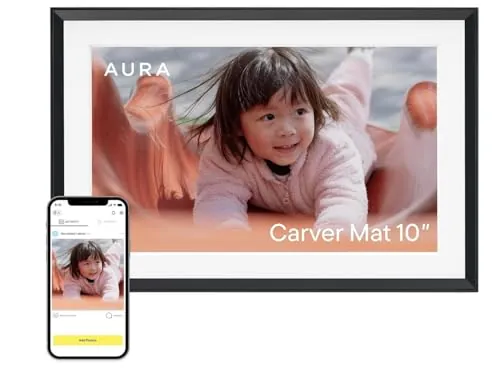
Aura Carver 10" WiFi Digital Picture Frame
- Very easy setup and day-to-day use, frequently described as intuitive
Comparison
Aura Carver is a Wi‑Fi digital picture frame built for sharing family photos through an app and cloud storage, while the KYY Portable Monitor is a 15.6-inch wired second screen for laptops, phones, and consoles. Aura focuses on effortless photo sharing and an always-on home display, whereas KYY prioritizes portability, device compatibility, and low-cost extra screen space. Both get strong clarity feedback, but each has some mixed reliability reports.
#1 Overall Winner
Contender
Choose Aura Carver if you want a dedicated digital picture frame that family can update remotely with minimal effort. Choose KYY if you want a portable 15.6-inch 1080p monitor for a laptop/phone/console setup, especially for travel or a small home office. If you’re buying mainly for gifting and daily photo enjoyment, Aura fits better; for productivity per pound and price, KYY makes more sense.
Overall winner
Depends on your needs
| Feature | Aura Carver 10" WiFi Digital Picture Frame | KYY Portable Monitor 15.6inch 1080P FHD (K3) | Winner |
|---|---|---|---|
| Primary use | Digital photo frame for shared memories | Portable external monitor for devices | Depends |
| Screen size | 10.1 in | 15.6 in | KYY Portable Monitor 15.6inch 1080P FHD (K3) |
| Resolution | 1080p | 1920 x 1080 | Tie |
| How content gets to the screen | Wi‑Fi + Aura app/cloud sharing | USB‑C or HDMI wired input | Depends |
| Setup experience | Designed for fast, simple setup | Generally plug-and-play; may vary by device | Aura Carver 10" WiFi Digital Picture Frame |
| Portability | Better as a stay-at-home frame | Travel-focused; slim and lightweight | KYY Portable Monitor 15.6inch 1080P FHD (K3) |
| Sharing with family/friends | Invite others to send photos/videos | Not applicable | Aura Carver 10" WiFi Digital Picture Frame |
| Included accessories | Not specified beyond frame | Cover/stand, screen protector, multiple cables | KYY Portable Monitor 15.6inch 1080P FHD (K3) |
| Auto on/off behavior | Auto on/off based on lighting | Not specified | Aura Carver 10" WiFi Digital Picture Frame |
| Audio | Short videos with sound supported | Built-in speakers + 3.5mm audio | Depends |
| Reliability sentiment | Mixed; some reports of sudden failure | Mixed; some reports of stopping/compatibility issues | Tie |
| Value for money (based on price and use) | Higher upfront cost; ongoing sharing value | Low cost for a second screen | KYY Portable Monitor 15.6inch 1080P FHD (K3) |
| Privacy/data considerations | App/cloud-based sharing workflow | Typically direct wired display use | KYY Portable Monitor 15.6inch 1080P FHD (K3) |
| Best fit for décor | Frame-like look intended for living spaces | Portable monitor aesthetic | Aura Carver 10" WiFi Digital Picture Frame |
In everyday home use, Aura Carver functions like décor: it sits in a shared space and cycles through family photos without needing a computer nearby. It’s especially useful if multiple people contribute photos remotely. The KYY monitor is more “task-based”—you bring it out when you need extra screen space for work, study, or entertainment, then pack it away. If you want a screen that blends into home life, Aura fits better; if you want a flexible tool for projects and screen extension, KYY is the better match.
Neither product directly changes temperature, air quality, or humidity, but both can affect comfort in a room. Aura Carver is designed to be an ambient display that’s pleasant to glance at, with brightness that adjusts to room lighting and auto on/off behavior that suits day-to-night routines. KYY can improve comfort in a home office or study area by adding screen space and reducing window juggling, but it’s more sensitive to bright ambient light where users report the display may feel less bright.
For their intended jobs, Aura Carver performs best when you want reliable, low-effort photo sharing and a frame-like presentation in the home. Reviews repeatedly highlight clear images, smooth uploading/deleting, and a display that looks good in real rooms. KYY performs well as a second screen, with many owners describing clear picture quality and smooth use for work and gaming; it can also run via a single USB‑C cable on compatible devices. Performance caveats show up as occasional KYY compatibility quirks and mixed reliability feedback for both products.
Both products have mixed reliability feedback. Aura Carver has a small but notable pattern of reports that units suddenly stop working, even alongside very high overall satisfaction. KYY is also described as reliable by many owners, but there are recurring mentions of units failing for some buyers and occasional connection quirks (such as needing to unplug/replug or being sensitive to device compatibility). If reliability risk worries you, prioritize a strong return window and test thoroughly soon after purchase.
Neither product comes with detailed safety certifications in the provided data, so the comparison is mainly about practical household risks. Aura Carver is a corded tabletop device, so safe placement means stable furniture, sensible cable routing, and keeping liquids away—especially in busy family areas. KYY is also an electrical device, and because it’s frequently moved, care around cable strain, port stress, and transporting it in a protective cover matters. For both, avoid overheating risks by keeping vents/areas around the device unobstructed and using the included/appropriate power connections.
Aura Carver tends to improve “home comfort” through convenience and atmosphere: it’s easy to keep updated with new family photos, and features like auto on/off and brightness adjustment help it feel natural in a living space. KYY improves comfort in a practical way by making computer tasks less cramped, especially on small laptop screens. If your comfort goal is a warmer home vibe, Aura fits better; if it’s reducing work friction and eye strain from constant window switching, KYY fits better.
Aura Carver is consistently described as extremely simple—setup is often reported as quick, and day-to-day use can be handled through the app without fiddling with storage devices. KYY is generally easy too, especially when USB‑C works as a one-cable solution, and buyers like that cables are included. However, KYY can require a bit more troubleshooting depending on the laptop or startup order, while Aura’s main learning curve is getting the recipient connected to Wi‑Fi.
Aura Carver is designed to blend into a living space: a frame-like look, a calibrated HD display, and automatic brightness adjustment for readability across day and night. It’s meant to be seen as home décor. KYY is designed like a travel accessory: ultra-slim, lightweight, and easy to prop up with the included magnetic cover/stand, with menu controls for adjusting settings. Pick Aura if aesthetics on a shelf matter; pick KYY if packability and a larger workspace matter.
Capacity matters differently here. Aura Carver’s “capacity” is mainly about how many photos/videos you can keep available through its cloud-based sharing approach, which is positioned as unlimited storage with no subscription. KYY’s capacity is physical screen real estate: its 15.6-inch panel gives you more room for spreadsheets, timelines, and side-by-side windows than Aura’s smaller display. If you need more workspace, KYY wins; if you want a constantly refreshed family gallery, Aura’s approach is more suitable.
KYY is highly space-efficient for small desks because you can store it flat when not in use, and it creates dual-screen workspace without a bulky monitor stand. Aura Carver is space-efficient in a different way: it occupies a small tabletop footprint and doubles as décor rather than equipment. For a small home office where the desk must stay clear, KYY is more flexible; for a shelf or side table display, Aura fits naturally.
Neither product is typically a noise source in normal use. Aura Carver may play short videos with sound, but that’s optional content rather than operating noise. KYY includes built-in speakers, which can add audio without extra devices, but again that’s user-controlled rather than fan/motor noise. For quiet rooms like bedrooms, both should be unobtrusive unless you’re playing audio.
Aura Carver installation is essentially: plug it in, connect to Wi‑Fi, and start adding photos—many buyers describe this as very fast. KYY installation is also straightforward, but it depends on your device: USB‑C may work as a one-cable solution on supported laptops, while others may need HDMI plus power. In short, Aura is simpler for a fixed home spot, while KYY is easy but slightly more variable because of device differences.
Aura Carver is frequently described as attractive and “quality-looking,” designed to sit out in the open like a real frame. That said, the mixed reliability feedback means build consistency may vary between units. KYY’s metal-look design and slim construction are praised, and the cover provides everyday protection in a bag, though some reviewers describe the case as functional rather than premium. Overall, both feel well-liked in hand, but neither is free from durability concerns in buyer feedback.
Aura Carver is intended to sit in one place, which usually reduces wear-and-tear, but mixed reliability reports suggest not every unit holds up the same way over time. KYY is designed to travel and includes a protective cover, which helps with scuffs and transport, but being portable also increases exposure to drops and bag pressure. Long-term durability for both appears “good for many, not for all,” based on the reliability patterns mentioned in reviews.
Aura Carver’s maintenance is mostly digital: adding/removing photos and keeping it connected to Wi‑Fi. There aren’t routine parts like filters, and owners often manage everything through the app. KYY’s maintenance is also light: keep the screen and ports clean, store it in the cover, and manage cables. Because KYY is frequently moved, cable/port care matters more, while Aura’s main upkeep is keeping sharing permissions and photo libraries organized.
KYY is the portability winner: it’s built to be carried, is slim and lightweight, and includes a cover that protects it and props it up. Aura Carver can be moved between rooms, but it’s better treated as a stationary display since it’s corded and designed to sit out like décor. If you want something you’ll use on trips, at co-working spaces, or between workstations, KYY is the clear choice.
Aura Carver’s standout features are sharing and presentation: invite family to contribute, send photos from an app, and display short videos with sound. It also includes auto on/off and options like slideshow adjustments and portrait/landscape behavior. KYY’s features focus on connectivity and travel use: dual USB‑C ports, mini HDMI, built-in speakers, a 3.5mm audio option, and an included smart cover that acts as a stand. If you want sharing features, Aura leads; if you want ports and device flexibility, KYY leads.
Aura Carver’s app experience is central to ownership: reviews frequently describe uploading, deleting, and managing photos as quick and intuitive, and it supports inviting other people to contribute. KYY doesn’t rely on an app in the provided data; setup is typically device-driven through USB‑C/HDMI. If you want app-based control and remote sharing, Aura is stronger; if you want to avoid app accounts and manage everything directly from your device, KYY is simpler.
Smart features matter much more with Aura Carver. It uses Wi‑Fi and the Aura app so family can send photos and videos remotely, and it supports options like inviting others to share. KYY is “smart” mainly in the practical sense—multiple ports, plug-and-play behavior, and a cover/stand—but it doesn’t offer app-based sharing or smart home integrations in the provided data. If connected, remote-updated display is the goal, Aura is the clearer fit.
Aura Carver is the only one with meaningful “smart” behavior in the provided data: Wi‑Fi connectivity, app-based sharing, invitations for multiple contributors, and integration with common photo sources. It’s designed to be remotely updated so relatives can contribute without being in the home. KYY doesn’t include smart home platform support or app control in the listed information; it’s a straightforward external display. If smart features are a deciding factor, Aura is the clear choice.
Aura Carver includes more hands-off automation for daily life, particularly its automatic on/off behavior tied to room lighting and slideshow controls. That makes it easier to leave in a living room without thinking about power every day. KYY is more manual: you connect it when you need it and disconnect it when you don’t. For automated, always-ready home display behavior, Aura is ahead.
Aura Carver connects over Wi‑Fi and relies on that connection for sending and updating photos/videos. That’s convenient for remote sharing but makes Wi‑Fi quality important. KYY connects via USB‑C or mini HDMI, with two USB‑C ports and a range of cables included, which is helpful across laptops and consoles. However, buyer feedback indicates that compatibility can vary by laptop, so confirming USB‑C video output support (or using HDMI) can prevent frustration.
KYY lists a specific power consumption figure and is designed to run efficiently, often drawing power via USB‑C on compatible setups, which can reduce extra adapters while traveling. Aura Carver is meant for always-available home display and includes auto on/off behavior to avoid running when the room is dark, but detailed power use isn’t provided. In practice, KYY is more “use it only when needed,” while Aura is more “ambient daily use,” so efficiency depends on how many hours you keep a screen active.
Privacy is more relevant for Aura Carver because it’s designed around sending and storing family photos and videos through an app and cloud workflow, with invitations for multiple contributors. That can be a positive for sharing, but it also means considering account access and who is invited. KYY generally acts as a wired display for whatever device you plug in, which typically exposes less personal data at the monitor level based on the provided information.
KYY offers strong value if your goal is an extra screen: you get a large 15.6-inch 1080p panel, multiple ports, and an included cover/cable kit at a very low price, and many buyers are impressed by what they get for the money. Aura Carver costs more, but its value is in the photo-sharing experience—easy remote updates, gift-friendly setup, and an always-on display that feels like part of the home. “Better value” depends on whether you’re buying productivity space (KYY) or a family-sharing display (Aura).
Aura Carver has very strong buyer sentiment and is positioned as a specialist in digital frames, with consistent feedback around ease of use and gifting. KYY has a large volume of reviews and many satisfied users, but feedback is more mixed around device compatibility and the included cover quality. With the information provided, Aura appears more established in its niche, while KYY competes primarily on price and portability.
Aura Carver has a very high average rating and a large review count, with repeated praise for simple setup, attractive appearance, and easy sharing for long-distance families. The most common negative theme is mixed reliability, including some reports of units stopping unexpectedly. KYY also has a large number of reviews and generally positive sentiment around value, portability, and clear picture quality, but there are more frequent mentions of compatibility differences across laptops and some reliability complaints. Overall, both satisfy many buyers, with Aura skewing more consistently positive.
Warranty and support clarity isn’t fully detailed in the provided data for either product. KYY’s listing mentions professional support availability, and some buyers comment positively on customer service, but specific warranty terms aren’t included here. If warranty coverage is important, check the seller/manufacturer warranty length, return window, and replacement process before buying.
Aura Carver and the KYY K3 don’t compete head-to-head so much as represent two different “screen” upgrades for the home. Aura Carver is the stronger choice for families: it excels at simple setup, remote photo sharing, and looking like a real frame in a living space, but it carries some mixed reliability feedback and depends on Wi‑Fi/app use. KYY is the better practical tool: a highly portable 15.6-inch second screen with flexible ports and strong value, though compatibility and reliability can be uneven and brightness may be challenged in very bright environments.
If your priority is gifting and daily memories on display, choose Aura. If your priority is productivity or travel-friendly screen space, choose KYY.

Overall winner
Depends on your needs
They’re built for different jobs. Aura Carver is better if you want a dedicated digital picture frame for effortless family photo sharing through an app and Wi‑Fi. KYY is better if you need a portable second screen for a laptop, phone, or console using USB‑C/HDMI. If your goal is daily memories on display, pick Aura; for productivity and travel, pick KYY.
Aura Carver is typically the easier “set it and forget it” option for photo display, with reviews repeatedly praising quick setup and simple sharing for parents and grandparents. KYY is also generally plug-and-play, but it may involve choosing the right cable/port and some users report occasional compatibility or reconnect steps depending on the laptop.
Aura Carver is the more natural gift choice because it’s designed as a photo frame, supports remote sharing from family, and can be preloaded before gifting. KYY can be a good gift for someone who works on a laptop or travels and wants more screen space, but it’s not purpose-built for family photo sharing.
Yes, Aura’s core experience is built around connecting to Wi‑Fi and using the Aura app (and supported services like email/text and photo libraries) to send photos and videos to the frame. If the home Wi‑Fi is unreliable, the sharing experience can be less consistent than a purely local, cable-based display.
Not necessarily. Reviews and product details suggest USB‑C can be a one-cable solution when the device supports the right USB‑C standard (often described as Thunderbolt/USB‑C full function). Some customers report compatibility issues with certain laptops, so it’s worth confirming your laptop’s USB‑C video output support or planning to use HDMI.
Both can suit small spaces, but in different ways. Aura Carver is compact and designed to live on a shelf or side table as decor. KYY is larger, but it’s very easy to pack away when not needed and can turn a small desk into a dual-screen setup without a permanent monitor stand.
KYY is clearly more portable: it’s designed to slide into a bag and includes a protective cover/stand for travel use. Aura Carver is more of a stationary home product that typically stays plugged in, making it less practical to move frequently between locations.
Both have mixed reliability feedback in customer reviews. Aura Carver has reports of some units suddenly stopping working, while KYY has a mix of “works out of the box” experiences and reports of units failing or needing occasional reconnect steps. If reliability is your top concern, consider buying from a retailer with an easy return process.
Check our rankings and expert guides to find the best home lifestyle products for your goals.