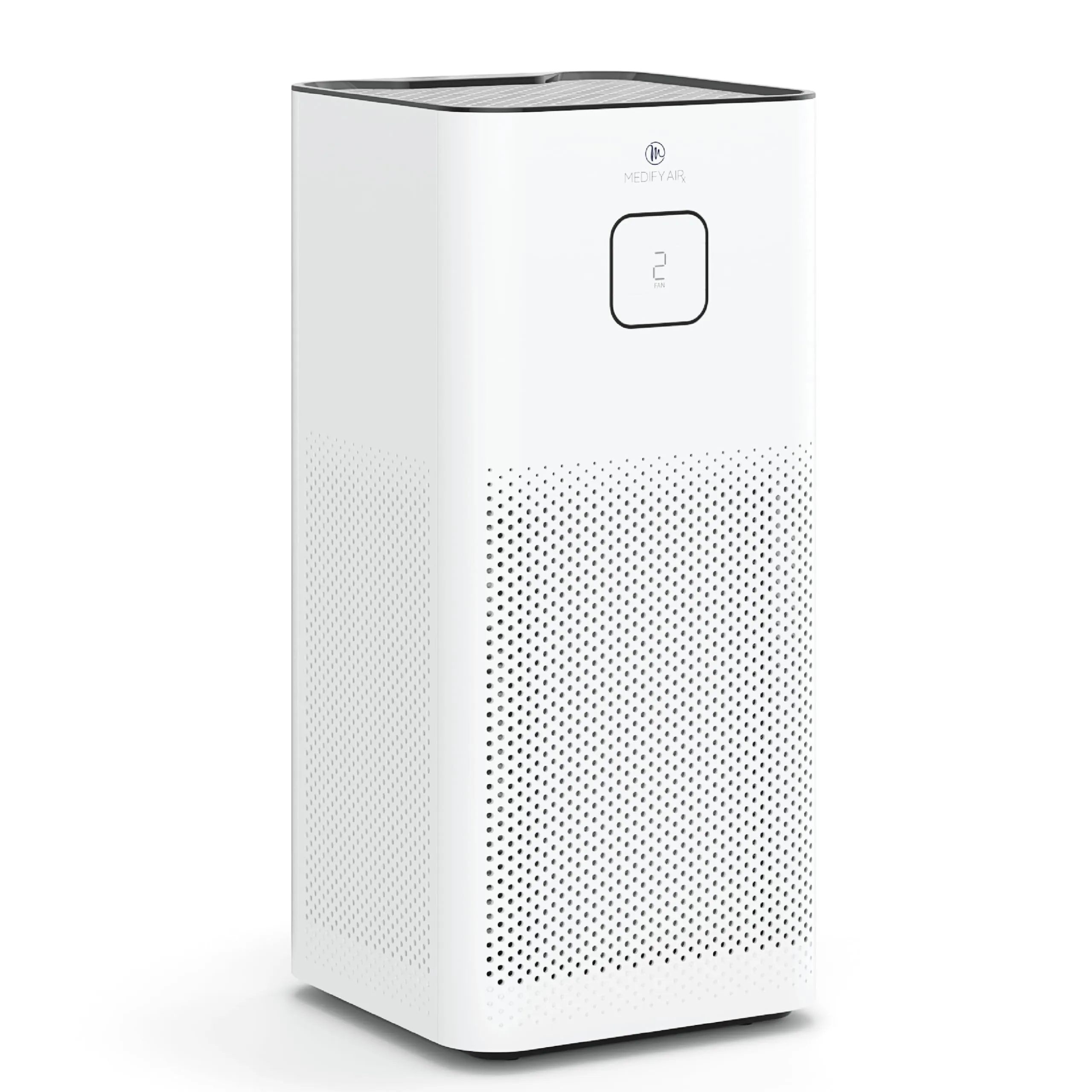
#1 Overall Winner
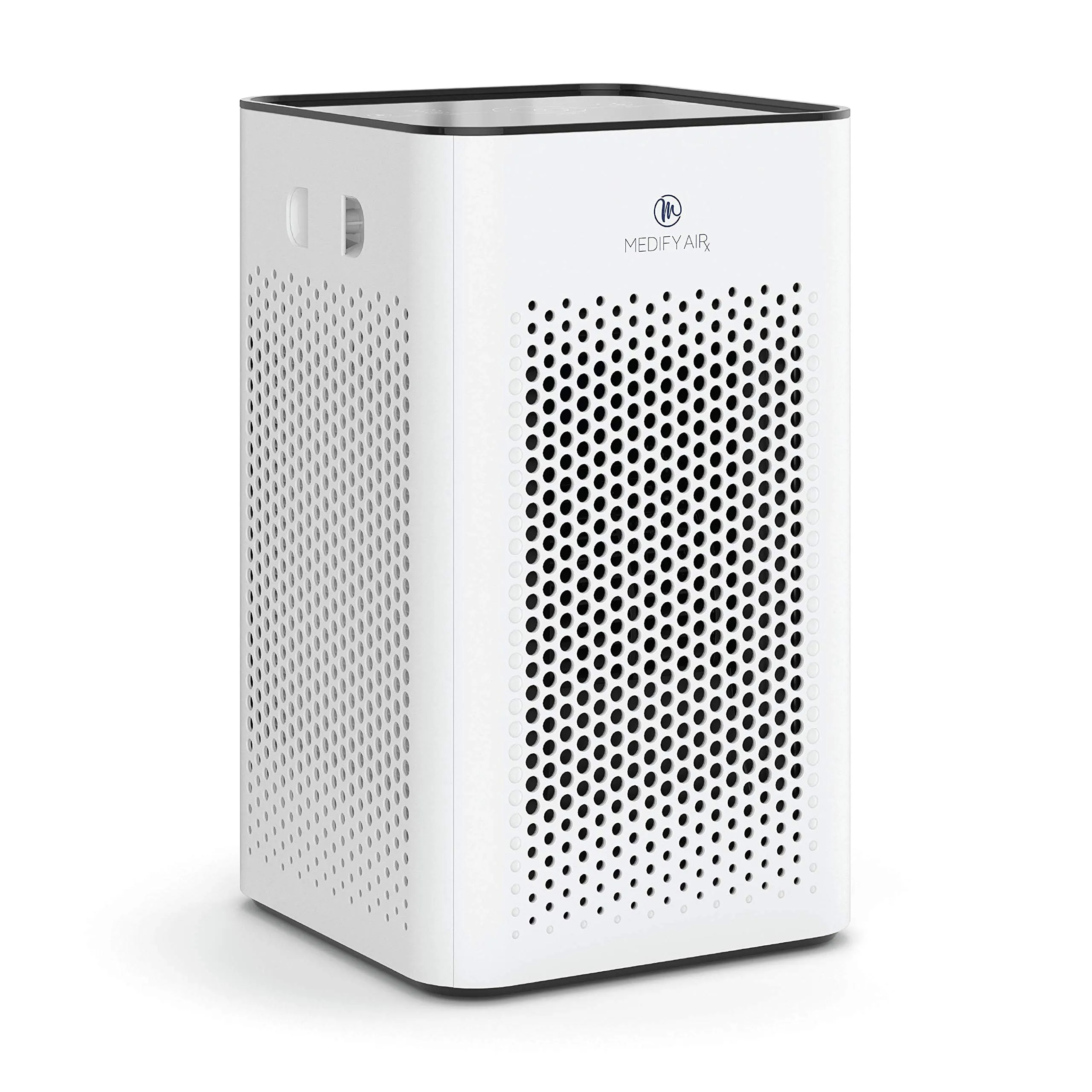
Medify MA-25 Air Purifier
- H13 True HEPA filtration is listed for particles down to 0.1 microns.
Comparison
The Medify MA-25 and MOOKA B-D02L are compact HEPA air purifiers designed for dust, pollen, pet dander, smoke, and odor concerns. Medify provides more detailed filtration and warranty information, while MOOKA costs far less, uses less listed power, and is easier to move around the home. Both have strong customer feedback, but MOOKA is the more practical value choice for many rooms and households.
#1 Overall Winner
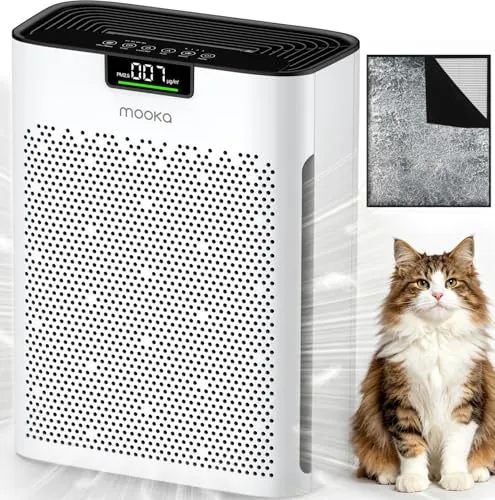
Contender
Choose the MOOKA B-D02L for affordable multi-room coverage, portability, and low-maintenance ownership. Choose the Medify MA-25 if its stated finer-particle filtration, filter-change indicator, and lifetime warranty are worth paying more for. Both are appropriate for bedrooms, pet areas, and allergy-conscious households, provided they are matched to the room and used with replacement filters.
Overall winner
Depends on your needs
| Feature | Medify MA-25 Air Purifier | MOOKA B-D02L Air Purifier | Winner |
|---|---|---|---|
| Listed price | $148.99 | $37.54 | MOOKA B-D02L Air Purifier |
| Stated maximum coverage | Up to 825 sq ft in one hour | Up to 1,076 sq ft | MOOKA B-D02L Air Purifier |
| Stated particle retention size | 0.1 micron | 0.3 micron | Medify MA-25 Air Purifier |
| Filtration | True HEPA H13 with dual filters | H13 True HEPA with pre-filter and activated carbon filter | Depends |
| Controls and timers | Touch panel; 0–8 hour timer | Touch/button controls; 1, 2, 4, and 8 hour timers | Depends |
| Noise | Listed 19.8–49.3 dB; mixed high-speed feedback | Listed 20 dB; mostly positive low-speed feedback | MOOKA B-D02L Air Purifier |
| Wattage | 28 watts | 13 watts | MOOKA B-D02L Air Purifier |
| Weight | 7.3 lb | 3.6 lb | MOOKA B-D02L Air Purifier |
| Maintenance | Filter indicator; filters listed for about 3–4 months | Filters listed for 3–6 months; simple replacement feedback | MOOKA B-D02L Air Purifier |
| Safety controls | Child lock; CARB and ETL listed | Child lock | Medify MA-25 Air Purifier |
| Warranty and support | USA registered lifetime warranty stated | Customer service claim; no warranty term supplied | Medify MA-25 Air Purifier |
| Overall value | Higher-cost model with stronger stated filtration detail | Low-cost, compact model with positive value feedback | MOOKA B-D02L Air Purifier |
Both models suit routine room-by-room air cleaning rather than whole-home HVAC filtration. The MOOKA is easier to carry between bedrooms, offices, pet areas, or living rooms because it weighs 3.6 pounds and has a small footprint. The Medify is better treated as a more permanent placement appliance because it is larger and needs airflow clearance, but its filter indicator and stated warranty can be helpful for long-term daily use. For several rooms, MOOKA's lower cost makes a multi-unit setup more realistic.
For home hygiene, both purifiers are intended to capture common airborne contaminants including dust, pollen, pet dander, smoke, and odors. Medify's listing provides the more detailed fine-particle claim and reviews mention dust collection and cooking or pet odors. MOOKA earns a slight practical edge for repeated use in different spaces because it is lighter, compact, and commonly praised for litter-box, musty, bathroom, and cooking-odor control. Neither replaces source cleaning, ventilation, or regular dust removal.
Neither appliance heats, cools, or controls humidity, but both can improve perceived room comfort by filtering airborne particles and odors. Medify's sleep mode dims the panel and its lower speed is often described as suitable for overnight use, although higher speeds can be more noticeable. MOOKA has especially favorable quiet-use feedback, a stated 20 dB noise level, and an optional night light. For bedrooms and workspaces where sound matters, MOOKA is the simpler comfort-first option.
Both products have strong supplied performance assessments and favorable customer feedback around dust, odors, allergies, and pet-related air concerns. Medify has the stronger stated filtration detail, claiming H13 performance down to 0.1 microns, and its 825-square-foot claim is specifically tied to one hour. MOOKA lists a larger maximum area but qualifies this with different air-change rates, including one change per hour at 1,076 square feet. In practical terms, both appear effective in bedrooms and typical occupied rooms; Medify favors specification-led filtration priorities, while MOOKA performs strongly for its price.
Both models have generally positive reliability signals from large review totals, including repeat purchases from buyers using multiple units. Medify has an advantage in support clarity: one long-term review describes a replacement after an LED issue, and the listing states a lifetime warranty. Its concerns are mostly practical, including costly filters and some noise at higher speeds. MOOKA has strong general feedback but less supplied warranty detail. Isolated reports mention a high-pitched sound when a unit is on but not running, and some users find it loud at higher settings.
Both products receive strong cleaning-performance feedback. Medify users often report visible dust accumulation on filters and improvement with pollen, pet dander, cooking smells, and sinus discomfort. MOOKA buyers similarly report reduced dust, fresher rooms, odor removal near litter boxes and laundry areas, and better bedroom comfort. Medify's stated 0.1-micron retention size gives it the specification advantage, but MOOKA has a small edge in the supplied cleaning assessment and delivers strong real-world feedback at a much lower price.
These are air-cleaning appliances rather than temperature or humidity-control devices. Both are relevant to indoor comfort where smoke, pollen, dust, pet dander, and odors are the concern. Medify's specification and review data more strongly emphasize filtration detail and its one-hour coverage claim. MOOKA's larger maximum coverage claim, quiet low-speed operation, and portability make it easier to use wherever comfort issues arise. Neither should be expected to cool a room, add humidity, or replace ventilation.
Both models include child-lock functions intended to reduce accidental setting changes by children or pets. Medify provides more specific safety-related information, including CARB and ETL listings, a touch control lock, and a supplied lifetime warranty. MOOKA also states child lock and uses an AC power adapter, with setup instructions emphasizing removal of the filter's plastic wrapping before use. No overheating, tip-over, or electrical failure pattern is established in the supplied reviews. For either unit, keep vents clear, use the correct power supply, and replace filters as directed.
Both purifiers receive reports of fresher-feeling rooms and reduced dust, odors, stuffiness, and allergy-related discomfort. Medify has a slight advantage for households that want the reassurance of a stated fine-particle claim and a darkened sleep setting. MOOKA is more comfortable for flexible everyday placement: it is lighter, more compact, and is often described as quiet beside a bed or during work. The optional night light may help some users, while others can switch it off for darkness.
The MOOKA B-D02L has the easier daily-use advantage. It is small, light, and repeatedly described as simple to operate and quick to re-filter. Its controls are straightforward, though buyers must remove the filter's plastic packaging and locate the adapter in the bottom compartment before first use. Medify's touch panel, child lock, timer, and filter indicator are convenient, but its placement requirements and control-light quirks can make it less effortless in a bedroom.
MOOKA is the more space-conscious design, measuring 7.1 by 7.1 by 11.1 inches and weighing 3.6 pounds. It is easy to place on a stool, shelf, or floor area and to transfer between rooms. Medify is still portable at 7.3 pounds but is larger and requires open space around its side and front vents, plus space behind it for the cord. Medify's top controls are accessible, though reviewers note this prevents using its top surface for anything else.
MOOKA lists the larger maximum coverage figure at up to 1,076 square feet, while Medify claims up to 825 square feet in one hour. The MOOKA listing also says it achieves six air changes per hour in 215 square feet but one air change per hour at its largest quoted area. This makes it sensible to use either model in a smaller, enclosed room when faster turnover is the priority. Medify's one-hour coverage statement is clearer, while MOOKA offers more stated maximum-area flexibility.
MOOKA is the stronger small-space option due to its compact 7.1-inch square footprint, low weight, and positive feedback about unobtrusive placement. It is suited to bedrooms, deskside areas, and flats where appliances must be moved or stored often. Medify can fit in bedrooms and apartments, but users should account for its 20 by 10 by 18 inch dimensions and leave space around the sides, front, and rear cord. That makes it less flexible near walls and furniture.
MOOKA is the better choice where quiet operation is a leading concern. Its listing states 20 dB, and many buyers describe its sleep or low mode as unobtrusive for sleeping, work, and television. Medify lists 19.8 dB at minimum and sleep-mode panel dimming, so it can also work well at low speed. However, reviewers more consistently flag Medify's highest speed as noticeable, while a minority of MOOKA reviews also report louder operation or an isolated high-pitched unit.
Neither purifier requires mounting or permanent installation; both are AC-powered appliances intended for plug-in use. MOOKA is particularly simple to set up because of its small, light body, but the supplied instructions note that the adapter is stored beneath the filter and that filter wrapping must be removed before operation. Medify also has straightforward placement, although its intake and outlet arrangement means it should not sit directly against walls. Leave clearance and avoid blocking vents on either model.
Medify has the better-supported build proposition. It is heavier, uses a dual-filter design, and has a stated lifetime warranty; reviews also include positive experiences with replacement support. MOOKA's compact construction is well liked for appearance and portability, but its supplied build assessment is less favorable and one user reported a high-pitched standby-like sound on a particular unit. Neither set of data establishes long-term component life, so filter availability and responsive seller support remain important ownership considerations.
Medify has the stronger durability case from the information provided because it is backed by a stated lifetime warranty and includes positive support feedback after a component issue. It also has a more favorable supplied build assessment. MOOKA buyers report units in use for around a year and repeat purchases, but its long-term support and warranty terms are not defined here. For either purifier, timely filter changes and keeping intake and outlet areas clear are likely more important than the housing finish alone.
MOOKA is the lower-maintenance ownership choice. Its filters are listed for replacement every three to six months depending on conditions, and buyers often describe changes as quick and replacement options as reasonably priced. Medify provides a useful filter replacement indicator and its filters are listed for 2,500 hours, or about three to four months. However, reviewers repeatedly mention higher replacement costs, and one international buyer reported trouble sourcing original filters. Check local filter availability before purchasing either model.
MOOKA clearly wins for portability. At 3.6 pounds and 7.1 by 7.1 by 11.1 inches, it is easy to shift between a bedroom, office, laundry space, or living area. Medify weighs 7.3 pounds and remains movable, but its larger dimensions and need for ventilation clearance make it less convenient to relocate frequently. Choose MOOKA for rotating use across rooms; choose Medify when it will primarily remain in one well-positioned area.
Medify offers three fan speeds, a 0–8 hour timer, sleep mode, panel dimming, a filter replacement indicator, and child lock through a touch panel. MOOKA offers four operating modes, four fixed timer settings, an on/off night light, and child lock. Its controls cover the basics but there is no stated filter indicator. Neither listing provides app control, air-quality sensing, remote control, scheduling beyond timers, or smart-home integration. Medify therefore has the more complete maintenance-focused control set, while MOOKA adds a useful bedside light.
MOOKA has the more favorable supplied efficiency profile. Its listed 13-watt draw is lower than Medify's 28 watts, and its low-power operation is positioned for continuous use. It also receives better efficiency assessment data. Medify does not lack efficiency features, since its timer and lower fan speeds can limit runtime, but ongoing filter expense weighs on overall ownership efficiency. Actual energy use will vary with fan setting and operating hours, and neither listing supplies measured yearly running costs.
MOOKA offers the clearer value proposition. It costs far less at purchase, has a lower listed wattage, and earns frequent praise for affordable filters, simple maintenance, and performance on dust and odors. This makes it especially attractive for households buying several units. Medify's price is higher, and filter expenses are a common complaint, so it is not the automatic value winner. Its added value comes from its stated 0.1-micron filtration, dual filters, filter indicator, child lock, clearer certification details, and stated lifetime warranty. The better value depends on whether those additions matter to your use case.
Medify has the stronger supplied brand-trust evidence. Its listing provides a USA registered lifetime warranty, CARB and ETL details, and a customer review describing responsive replacement support. MOOKA has a substantial review base and many repeat buyers, which supports confidence in its everyday appeal, but the supplied information gives less clarity on warranty terms and long-term service arrangements. Buyers prioritizing formal support information should lean Medify; buyers prioritizing broad user approval at a low price may still be comfortable with MOOKA.
Both products have high star ratings from large review counts and earn repeated praise for dust reduction, odor removal, allergy comfort, and compact home use. MOOKA has the stronger supplied customer-satisfaction assessment, with many buyers purchasing multiple units and highlighting quiet sleep operation, simple replacement, and value. Medify feedback is also very positive, particularly for allergies, pet dander, filtration, and support. Its recurring complaints are expensive filters, louder high-speed operation, clearance needs, and occasional issues with lights or international replacement-filter availability.
Medify is the clear choice for warranty clarity. Its listing states a USA registered lifetime warranty, and a reviewer reports a replacement unit being provided after an LED fault. MOOKA promises customer service but does not provide a specific warranty length in the supplied information. Before buying MOOKA, confirm the current warranty, seller support route, and replacement-filter availability in your location.
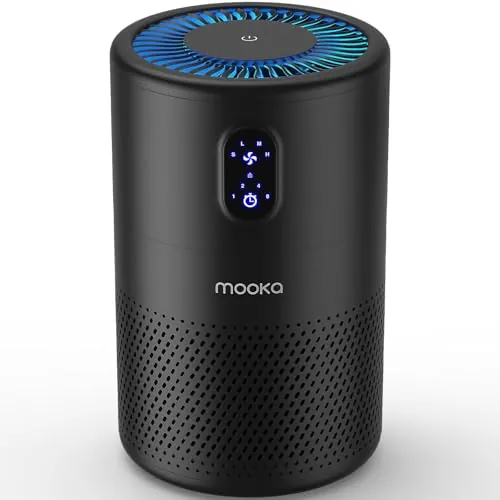
The MOOKA B-D02L is the overall winner for most households. It combines strong reported air-cleaning results with a much lower price, compact form, low stated wattage, quiet low-speed operation, and easier filter ownership. Its limitation is a simpler feature set and less clearly defined warranty support.
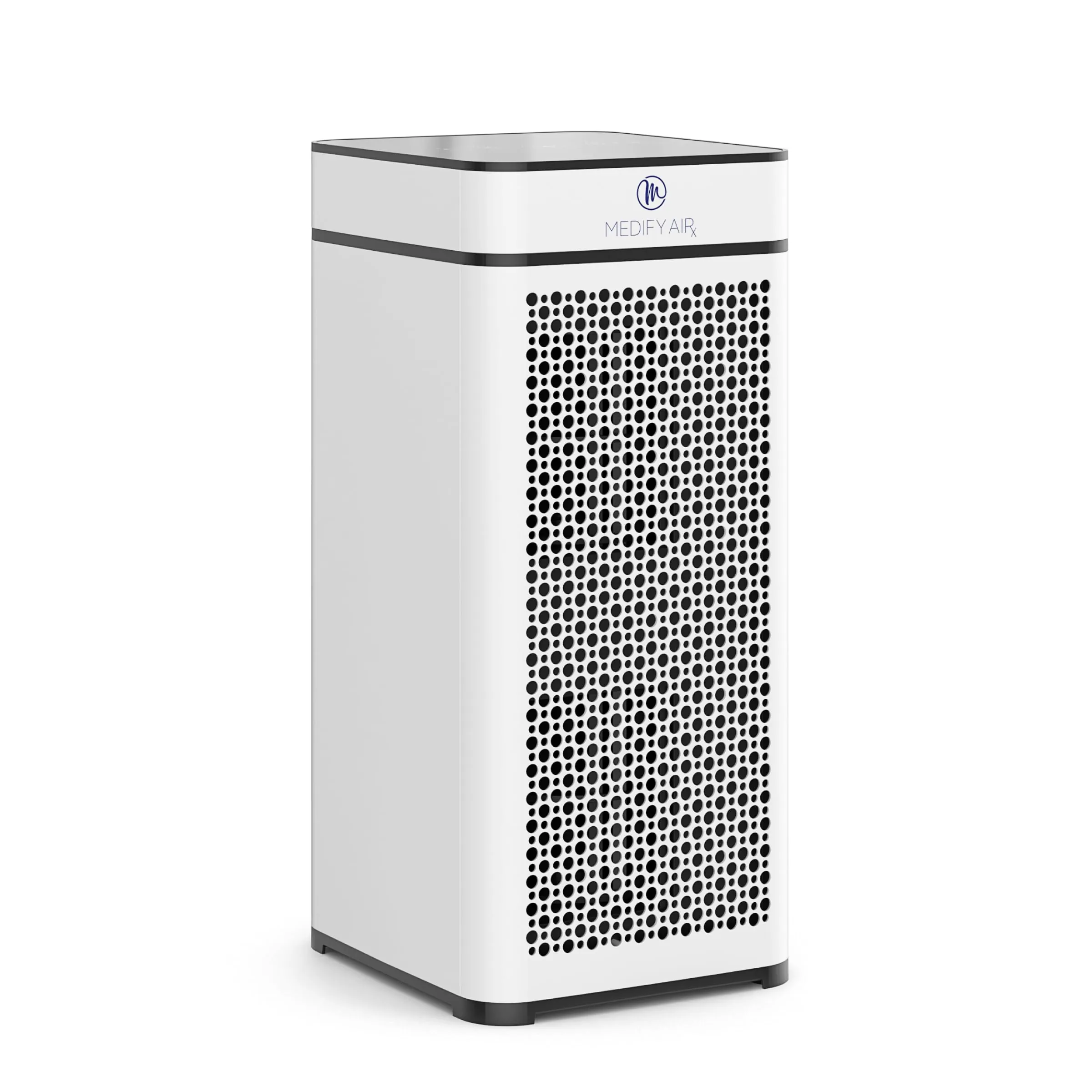
The Medify MA-25 is the more specification- and support-led alternative. Its stated 0.1-micron filtration, dual filters, filter indicator, child lock, and lifetime warranty will appeal to buyers with focused allergy or fine-particle concerns. Its main limitations are more expensive filters, larger placement demands, and greater high-speed noise. Select MOOKA for broad value; select Medify when its extra filtration and warranty details outweigh cost.

Overall winner
Depends on your needs
The MOOKA B-D02L is the stronger overall choice for shoppers focused on low upfront cost, compactness, quiet operation, and simple maintenance. The Medify MA-25 is the better fit for buyers who prioritize its stated 0.1-micron particle retention, filter indicator, child lock, and stated lifetime warranty. Both have strong buyer feedback for dust, odors, and allergy-related comfort.
The MOOKA B-D02L is more suitable for small spaces when portability and footprint matter most. It measures 7.1 by 7.1 by 11.1 inches and weighs 3.6 pounds, making it easier to reposition. The Medify MA-25 is still compact enough for bedrooms, but its listed dimensions and wall-clearance needs demand more placement planning.
The MOOKA B-D02L has the advantage for low-noise use based on its stated 20 dB level and frequent review praise for sleep mode. Medify lists a low setting of 19.8 dB and a sleep mode that dims the panel, but feedback is more mixed at higher speeds. Either can be suitable overnight on a low setting.
Based on the supplied listings, Medify states that its H13 filter removes particles down to 0.1 microns, while MOOKA lists airborne contaminants as small as 0.3 microns. These are manufacturer-provided filtration claims, not a direct like-for-like test result. The two models also differ in room-size and airflow claims, so filtration size alone should not determine placement.
The MOOKA B-D02L is the easier maintenance choice in the provided comparison. Reviews describe a quick filter-change process and affordable replacement options, though its filter replacement interval is listed as three to six months depending on use. Medify has a filter indicator and accessible dual filters, but buyers repeatedly note higher replacement-filter costs.
The MOOKA B-D02L offers better value for most budget-conscious households. Its price is much lower, its power rating is lower, and customer feedback is favorable about replacement-filter costs. The Medify MA-25 costs more but adds stated 0.1-micron filtration, more detailed control features, and a stated lifetime warranty, which may justify the additional cost for some buyers.
No smart-home, Wi-Fi, app, voice-assistant, or remote-control compatibility is stated for either model in the supplied information. Their controls are designed for direct use on the unit. Choose between them based on filtration claims, room placement, noise preferences, timer options, and ongoing filter costs rather than connected-home features.
Check our rankings and expert guides to find the best home lifestyle products for your goals.