
#1 Overall Winner
Beurer EM59 Digital 3-in-1 TENS Unit, EMS & Heat Therapy
- Combines TENS, EMS, and heat in one compact unit for varied pain relief and muscle stimulation use cases
Comparison
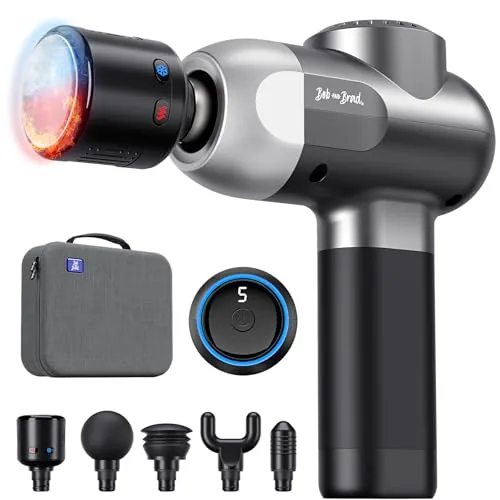
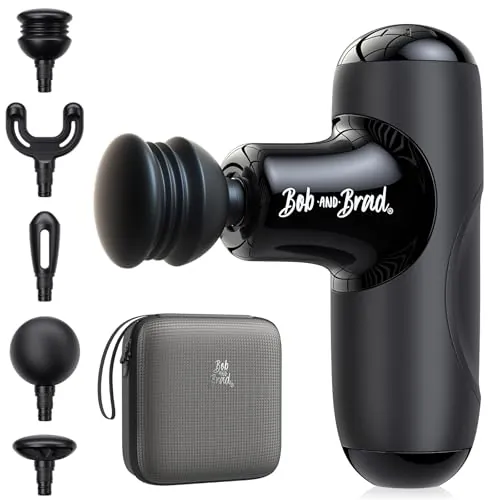
The Beurer EM59 and Bob and Brad Q2 Mini both target muscle discomfort and recovery, but they do it in different ways: the EM59 uses TENS/EMS stimulation plus heat, while the Q2 Mini is a compact percussion massage gun. If you want program-based sessions and dual-channel electrode placement, the EM59 stands out. If you want quick, easy deep-tissue-style massage with very high buyer satisfaction, the Q2 Mini is the more straightforward choice for most households.
#1 Overall Winner
Contender
Pick the Beurer EM59 if you want TENS/EMS stimulation with lots of guided programs and dual-channel electrode placement for targeted sessions. Pick the Bob and Brad Q2 Mini if you want a compact, quiet(ish) percussion massager that’s easy to use, travels well, and is widely praised for power and overall value. If you dislike consumables and setup, the Q2 Mini is usually simpler.
Overall winner
Depends on your needs
| Feature | Beurer EM59 Digital 3-in-1 TENS Unit, EMS & Heat Therapy | BOB AND BRAD Q2 Mini Massage Gun | Winner |
|---|---|---|---|
| Product type | TENS/EMS unit with heat mode | Percussion massage gun | Depends |
| Primary use case fit | Pain relief + stimulation programs | Muscle recovery + knot relief | Depends |
| Portability | Very compact; belt clip; 6.7 oz | Pocket-sized; carry case; 15.17 oz | BOB AND BRAD Q2 Mini Massage Gun |
| Noise in use | Silent operation typical of TENS/EMS | Very quiet for a massage gun | Beurer EM59 Digital 3-in-1 TENS Unit, EMS & Heat Therapy |
| Controls & learning curve | Many programs; mixed ease-of-use feedback | Simple speeds; commonly described as easy one-handed use | BOB AND BRAD Q2 Mini Massage Gun |
| Programs / modes | 64 pre-programmed + 6 customizable programs | Adjustable speeds; multiple attachments | Depends |
| Targeting two areas at once | Two adjustable channels; 4 electrodes | Single massage head at a time | Beurer EM59 Digital 3-in-1 TENS Unit, EMS & Heat Therapy |
| Maintenance & consumables | Pads may wear and need replacing; stickiness complaints | No adhesive pads; keep attachments clean; charge battery | BOB AND BRAD Q2 Mini Massage Gun |
| Heat experience (per reviews) | Heat included, often described as mild | Some reviews mention a heating head (variant-dependent) | Depends |
| Battery feedback | Mixed; some recharge often | Mixed; some report charge-holding issues | Tie |
| Customer satisfaction trend | Good overall; repeated pad complaints; value opinions divided | Very high overall sentiment; strong value perception | BOB AND BRAD Q2 Mini Massage Gun |
| Value for money (based on provided context) | Higher price; recurring pad concerns | Lower price; widely seen as worth it | BOB AND BRAD Q2 Mini Massage Gun |
| Best for discreet use at work | Silent; belt clip; can run timed sessions | Quiet but still percussive tapping | Beurer EM59 Digital 3-in-1 TENS Unit, EMS & Heat Therapy |
| Best for quick “spot treatment” | Requires pad placement each session | Fast to apply on calves/back/feet with an attachment | BOB AND BRAD Q2 Mini Massage Gun |
For everyday home use, both products can slot into a routine after workouts or long desk days, but they feel very different in practice. The Beurer EM59 is session-based: you place electrodes, choose a program, and let it run on a timer, which can be convenient when you want hands-free relief. The Bob and Brad Q2 Mini is more interactive: you hold it and work over specific muscle groups, which suits quick spot treatments and sharing between family members without re-positioning pads.
These are comfort and recovery devices rather than climate products, but comfort still matters. The Beurer EM59’s quiet operation and timed programs can work well for wind-down routines, and some users appreciate having heat available even if it’s subtle. The Bob and Brad Q2 Mini is commonly used for relaxation and muscle relief, and is described as quiet enough for TV/office settings, though it still creates percussion vibration that may not suit everyone late at night.
For perceived effectiveness, the Bob and Brad Q2 Mini has the clearer advantage in the provided data: buyers repeatedly describe strong deep-tissue-style relief despite its compact size, and overall sentiment suggests it performs consistently for sore muscles and tightness. The Beurer EM59 is also often described as effective for pain relief (notably lower back and knee soreness), with plenty of program variety to fine-tune the sensation.
Where the EM59 can lose practical performance is pad quality: if electrodes don’t stick well, sessions become harder to run consistently. Heat is a bonus feature on paper, but multiple reviews say the warmth is mild.
Reliability signals differ between the two. With the Beurer EM59, the most consistent reliability issue is functional rather than electronic: multiple reviews mention the electrode pads losing stickiness quickly, which can make the device hard to use even if the unit itself works. Battery life also has mixed feedback, suggesting some users recharge frequently.
With the Bob and Brad Q2 Mini, overall reliability sentiment is strong, but there are reports of charging problems and batteries not holding charge for some users. Several reviews also describe responsive support and replacements, which may reduce the practical impact if you encounter an issue.
Both products are marketed for home wellness use and include auto shut-off, which can help reduce overuse during longer sessions. For the Beurer EM59, a practical safety-and-hygiene consideration is the condition of adhesive pads: multiple reviews mention pads arriving or becoming non-sticky, and worn pads may not apply consistently or hygienically if they pick up residue. Planning for timely pad replacement matters.
For the Bob and Brad Q2 Mini, safety is mainly about controlled use of a percussion device (avoiding sensitive areas and using an appropriate speed/head). The small size can help with handling control, but users should still start gently and increase intensity as tolerated.
Comfort depends on the sensation you prefer. The Beurer EM59 provides controlled stimulation with many program options and a timer, which some users find relaxing and helpful for pain distraction during work or recovery. Comfort can drop if pads don’t adhere well or if the heat mode feels too subtle.
The Bob and Brad Q2 Mini is often described as providing immediate, satisfying muscle relief and being comfortable to hold thanks to its compact size and grip. If you like deep-tissue-style pressure without much setup, it tends to feel more convenient.
Ease of use generally favors the Bob and Brad Q2 Mini. Reviews commonly mention that it’s easy to handle with one hand, and the workflow is simple: pick a head, pick a speed, and use it.
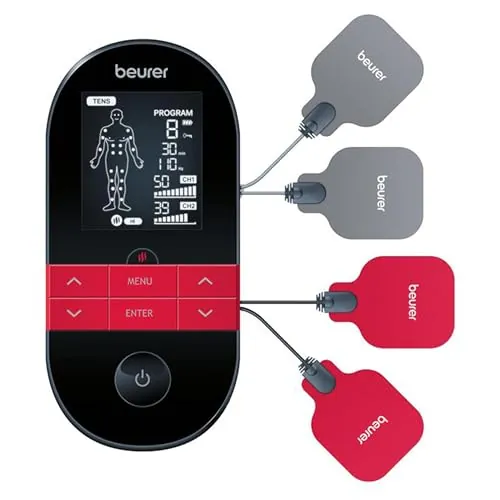
The Beurer EM59 has more steps and more choices. The inverse LCD display is meant to guide pad placement and selection, but feedback is mixed—some users find it easy, while others find the program options and setup more complicated than expected.
The Beurer EM59 is designed around compact, wearable-style use: a small body, belt clip, dual channels, and a screen intended to help you place electrodes correctly. It suits hands-free sessions where the device can run while you sit or work.
The Bob and Brad Q2 Mini is designed for grip and maneuverability, with an ergonomic handle and a small footprint that’s easy to pack. If you plan to treat different muscle groups quickly (calves, feet, back), the hand-held form factor is typically more flexible.
“Capacity” here is more about coverage and session flexibility than a tank or bin. The Beurer EM59’s dual channels and four electrodes let you treat two adjacent areas at the same time, which can feel like greater coverage in a single session. The Bob and Brad Q2 Mini focuses on one treatment point at a time, but attachments and speed settings let you cover multiple muscle groups quickly as you move the device.
Neither device takes much space, but they store differently. The Beurer EM59 has a very small footprint, though you’ll also need space for spare electrode pads if you use it frequently. The Bob and Brad Q2 Mini is still compact and comes with a case that keeps the gun and heads organized, which helps prevent drawer clutter.
For very small living spaces or minimal-storage households, both work well; the Q2 Mini’s case is tidier, while the EM59’s main unit is smaller.
If noise is a priority, the Beurer EM59 has the advantage because electrical stimulation devices operate quietly. That makes it easier to use in shared rooms, at the office, or while watching TV without adding sound.
The Bob and Brad Q2 Mini is frequently described as very quiet for a percussion device, but it still produces audible tapping and vibration compared with a TENS/EMS unit. It’s a good choice if you want a quieter massage gun, not absolute silence.
Build quality impressions lean stronger for the Bob and Brad Q2 Mini, with reviewers describing a solid feel, tight seams, and a well-made carry case. That aligns with the generally high satisfaction and design scores in the provided data.
The Beurer EM59 is often described as good quality and well-functioning, but recurring pad complaints can make the overall ownership experience feel less robust. The core unit appears well-liked; the weak point is the consumable electrode system.
Long-term durability looks stronger for the Bob and Brad Q2 Mini in the provided data, supported by high buyer satisfaction and frequent “well-made” comments. The main durability watch-out is battery longevity, since mixed feedback includes charge-holding concerns.
The Beurer EM59’s durability is more complicated: the core device may last, but the pads are a known wear item and are widely reported to degrade quickly. If you use it often, pad replacement frequency can become the limiting factor in the long run.
Maintenance is one of the clearest differences. The Beurer EM59 requires electrode pad care and replacement; many owners mention stickiness fading and needing to buy more pads. That adds recurring upkeep beyond simply charging the unit.
The Bob and Brad Q2 Mini is simpler: keep attachments clean, store it in its case, and charge via USB-C. While any battery device needs charging habits, it avoids consumable adhesive parts, making it easier to live with for many households.
Both are strong choices for portability. The Beurer EM59 is extremely light and compact, and the belt clip helps if you want to move around during a session. The Bob and Brad Q2 Mini is also highly portable, and the included carry case makes it easier to pack attachments neatly for travel or gym bags.
If you want truly discreet portability and silent operation, the EM59 has an edge. If you want a single self-contained kit that’s quick to pull out and use, the Q2 Mini’s case and simple workflow are hard to beat.
The Beurer EM59 is feature-dense in a “program” sense: it combines TENS, EMS, and heat, includes dual adjustable channels, and offers many preset applications plus customizable programs and a long timer range. That makes it appealing if you like guided sessions and fine-grained control.
The Bob and Brad Q2 Mini is feature-forward in a “tooling” sense: adjustable speeds, multiple attachments, USB-C charging, and a carry case. It’s designed to be quick to use and adaptable across muscle groups without electrode placement.
In day-to-day efficiency, the Bob and Brad Q2 Mini tends to be faster to deploy: no pad placement, no adhesive wear to manage, and simple controls. That can lead to more frequent use because it’s easy to do a short session when you have a few minutes.
The Beurer EM59 can be efficient once set up because you can run hands-free timed sessions, but pad stickiness issues and the need to replace electrodes can add friction and ongoing cost, which affects overall “ownership efficiency” for some users.
Value favors the Bob and Brad Q2 Mini in the provided data. It’s lower priced, has very high buyer satisfaction, and is frequently described as worth the money as a recovery tool. The included carry case and attachments also support day-to-day usefulness without obvious recurring consumable costs.
The Beurer EM59 can still be good value if you specifically want TENS/EMS programs and dual-channel sessions, but value opinions are divided in reviews. Ongoing replacement pad needs and concerns about pad pricing/compatibility can make the long-term cost feel higher than expected for frequent users.
Based on the provided reviews, Bob and Brad’s brand trust is supported by strong overall sentiment and multiple detailed accounts of responsive customer service when something goes wrong. That can matter if you’re worried about battery or charging issues.
Beurer’s EM59 has a large review base and many reports of effective pain relief, but recurring pad complaints and cost concerns can reduce confidence in the overall ownership experience. Without clearer warranty/support details in the provided data, brand trust here relies mainly on user feedback patterns.
Customer satisfaction is strong for both, but it’s clearly higher and more consistent for the Bob and Brad Q2 Mini. With a higher star rating and a very large review count, the dominant themes are strong power, compact size, quiet operation for a massage gun, and ease of use. Battery life is the main area of disagreement.
The Beurer EM59 also has many positive experiences, especially for pain relief and portability, but the same complaints recur: pads not sticking well, pads wearing quickly, mixed battery life, and mixed opinions on ease of use. Those issues create a more divided ownership experience.
The Bob and Brad Q2 Mini has multiple reviews describing responsive customer support and replacement help when charging issues occurred, and the listing mentions a customer care promise. For the Beurer EM59, the provided information doesn’t include clear warranty/support specifics, so expectations are harder to set; most ownership concerns mentioned are practical (pads, heat intensity, and ongoing costs) rather than support outcomes.
The Bob and Brad Q2 Mini is the clearer overall winner for most buyers: it delivers strong perceived percussion massage performance in a very compact design, is widely described as easy to use, and has consistently high customer satisfaction at a lower price. Its main limitation is mixed feedback around battery/charging reliability.
The Beurer EM59 is a better niche pick if you want TENS/EMS-style stimulation with lots of programs, dual-channel targeting, and very quiet operation. Its main limitation is the electrode ecosystem—pads are widely reported to lose stickiness quickly, and replacement cost/availability concerns can reduce value over time. If you’re deciding purely on hassle-free daily use, the Q2 Mini is usually the safer choice.
Overall winner
Depends on your needs
If you want electrical stimulation programs (TENS/EMS) with dual channels and lots of presets, the Beurer EM59 fits that brief. If you prefer a straightforward percussion massage tool that’s compact, quiet, and widely praised for ease of use and overall value, the Bob and Brad Q2 Mini is the stronger all-round pick. The best choice depends on whether you prefer stimulation pads or percussive massage.
The Beurer EM59 uses adhesive electrode pads to deliver TENS/EMS electrical stimulation and includes a heat mode. The Bob and Brad Q2 Mini is a percussion massage gun that uses rapid tapping with interchangeable heads. TENS/EMS tends to be about controlled stimulation sessions, while percussion is more about loosening tight muscles and working on knots with manual targeting.
The Bob and Brad Q2 Mini is generally easier for most people because it’s a “grab, choose a speed, and massage” device, and buyers often mention one-handed use. The Beurer EM59 can take more setup because you need to place pads correctly and choose from many programs, and reviews are mixed on whether it feels intuitive or complicated.
Both are portable and cordless, but they suit different situations. The Beurer EM59 is extremely quiet in operation and clips on with a belt clip, which can work well for discreet use. The Bob and Brad Q2 Mini also travels well and comes with a carry case; it’s described as quiet for a percussion massager, but it still creates some vibration and sound.
The Beurer EM59 may have more recurring costs because the adhesive electrode pads wear out and several reviews mention that the pads lose stickiness quickly and replacements can be expensive. The Bob and Brad Q2 Mini doesn’t use consumable pads in the same way; most ongoing “cost” is simply charging the battery and keeping track of the attachments.
The Beurer EM59 operates silently in the way most TENS/EMS units do, making it easy to use without bothering others. The Bob and Brad Q2 Mini is repeatedly described as very quiet for a massage gun, but it is still a motorized percussion device, so it will create audible tapping and vibration compared with a stimulation unit.
Both can help, but they approach recovery differently. Many EM59 owners mention relief around areas like knees and lower back using stimulation and heat, though pad quality can affect consistency. The Q2 Mini is frequently praised for strong, targeted deep-tissue-style relief in a small body, which suits quick post-workout sessions when you want to work on tight spots.
For the Beurer EM59, the most repeated issue is pad adhesiveness and the practical impact that has on usability; battery life opinions are mixed. For the Bob and Brad Q2 Mini, overall satisfaction is very high, but there are reports of charging or battery longevity issues in a minority of experiences, sometimes followed by responsive customer support.
Check our rankings and expert guides to find the best home lifestyle products for your goals.