#1 Overall Winner
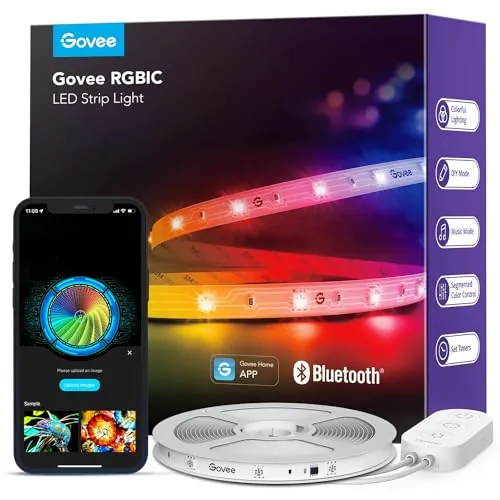
Govee RGBIC LED Strip Lights (16.4ft, Bluetooth, H617A)
- RGBIC effects can show multiple colors on one strip for more dynamic gradients
Comparison
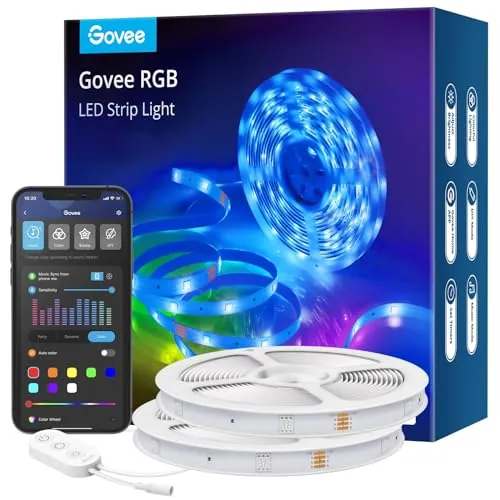
The Govee H617A is a 16.4ft RGBIC Bluetooth LED strip built for gradient-style effects and app-driven scenes, while the Govee H6110 is a 32.8ft Wi‑Fi strip designed for Alexa/Google voice control and longer installs. Both are popular indoor mood-lighting options with music sync and strong brightness feedback. The choice mainly comes down to whether you prioritize RGBIC effects or smart-home voice integration and length.
#1 Overall Winner
Contender
Choose the Govee H617A if you want RGBIC multi-color effects for mood lighting and you’re happy controlling everything in the app over Bluetooth. Choose the Govee H6110 if you want a longer 32.8ft run and voice control with Alexa or Google Assistant. Both are easy to install for most users, but careful handling and testing before final mounting can help avoid frustration.
Overall winner
Depends on your needs
| Feature | Govee RGBIC LED Strip Lights (16.4ft, Bluetooth, H617A) | Govee Smart RGB LED Strip Lights (32.8ft, Wi‑Fi, H6110) | Winner |
|---|---|---|---|
| Type of strip | RGBIC strip (multi-color on one line) | RGB strip (standard color changing) | Govee RGBIC LED Strip Lights (16.4ft, Bluetooth, H617A) |
| Total length included | 16.4ft (single strip) | 32.8ft (two 16.4ft rolls) | Govee Smart RGB LED Strip Lights (32.8ft, Wi‑Fi, H6110) |
| Voice assistant support | Not Alexa (stated) | Alexa + Google Assistant | Govee Smart RGB LED Strip Lights (32.8ft, Wi‑Fi, H6110) |
| Primary connectivity | Bluetooth/app control | Wi‑Fi + Bluetooth | Govee Smart RGB LED Strip Lights (32.8ft, Wi‑Fi, H6110) |
| App control features | Govee Home app with DIY, scenes, themes | Govee Home app with DIY, timer, scenes | Tie |
| Music sync | Yes (multiple music modes noted) | Yes (built-in mic noted) | Tie |
| Brightness (as described by buyers) | Often described as bright and adjustable | Often described as very bright and adjustable | Depends |
| Power draw (listed) | 12W | 36W | Depends |
| Installation reinforcement | Adhesive-backed strip (surface prep recommended) | Adhesive + included support clips | Govee Smart RGB LED Strip Lights (32.8ft, Wi‑Fi, H6110) |
| Corner/handling tolerance (based on reviews) | Reports of tearing/breaking if not careful | Users emphasize gentle installation to avoid joint stress | Tie |
| Color accuracy complaints | Generally vibrant; some note LED spacing affects look | Mixed; some say white looks blue | Govee RGBIC LED Strip Lights (16.4ft, Bluetooth, H617A) |
| Reliability sentiment | Mixed; some units stop working | Mixed; some sections fail/stop working | Tie |
| Best for smart-home routines | Limited (no Alexa) | Better (Alexa/Google + Wi‑Fi) | Govee Smart RGB LED Strip Lights (32.8ft, Wi‑Fi, H6110) |
| Price (listed) | Lower cost | Higher cost | Depends |
For everyday home use, both strips work well as flexible accent lighting—behind headboards, under desks, along shelving, or around entertainment areas. The H617A tends to suit “set the vibe” lighting where you want animated gradients and multi-color effects that look more dynamic in the room. The H6110 is better when you want the lights to behave like part of your smart home, especially if you already use Alexa or Google routines for bedtime, movie time, or scheduled on/off lighting.
Both can work for kitchen accents such as under-cabinet or shelf lighting, but they’re best used as indirect light rather than exposed task lighting. The H6110’s longer length makes it easier to cover more cabinetry in one kit, and customer feedback specifically mentions good appearance in kitchen settings. The H617A can look great under islands or shelves, but reviewers note the individual LED dots are more noticeable when the strip is in direct view—so placement behind a lip or trim matters.
Neither product changes temperature or air quality, but both can improve perceived comfort by adding adjustable ambient light. The H617A’s RGBIC gradients are particularly effective for mood lighting in bedrooms and entertainment areas. The H6110 supports voice control, which can make nightly routines easier (for example, dimming or switching scenes without reaching for a phone). Comfort impact will depend mostly on where the strip is mounted and whether you use diffused/indirect placement.
Both products perform well for their main purpose—creating adjustable, colorful accent lighting—with buyers frequently praising brightness and the ability to dim. The H617A’s standout performance trait is its RGBIC behavior, producing more visually complex gradients and animated effects on a single strip. The H6110’s performance advantage is coverage: the longer kit and high LED count are better suited to lighting more of a room in one go. Performance concerns for both center on consistency over time, with some reports of strips or sections stopping working.
Reliability is mixed for both. On the H617A, some owners report the strip works perfectly (including long daily usage), while others describe units that stop working or fail after physical stress, especially around corners or damaged sections. On the H6110, many buyers report stable operation and easy Wi‑Fi/Alexa linking, but there are repeated mentions of sections failing after months and occasional connectivity issues. With either strip, testing before final install and avoiding sharp bends can reduce avoidable failures.
Both products are corded indoor LED strip kits that rely on adhesive mounting, so the main practical safety considerations are secure placement, cable management, and avoiding damaged sections. If a strip is bent sharply, torn, or stressed at joints, it may fail, so taking your time during installation is important. Both listings note indoor use and recommend clean, dry surfaces for proper adhesion; loose strips can sag or peel, creating snag risks. The H6110 notes an adapter that is ETL listed, which can be a reassuring detail for the power component. Neither is described as waterproof, so keep them away from sinks, splashes, and damp areas.
For comfort and ambiance, both strips let you dim brightness and pick colors that suit relaxing, gaming, or entertaining. The H617A is better when comfort means “visual mood” through gradients and multi-color scenes that feel more immersive. The H6110 is better when comfort means convenience—being able to turn lights on/off or dim them via Alexa/Google without opening the app. Placement (indirect vs exposed) will strongly affect how relaxing the lighting feels.
Both strips are generally described as easy to set up, with straightforward app pairing and adhesive installation when surfaces are cleaned and dried first. The H6110 can be simpler day-to-day if you prefer voice commands over phone control, and it includes clips to help keep the strip secured. The H617A is also very beginner-friendly in the app, but you’ll rely on the phone for most control since Alexa isn’t supported.
The H617A’s design advantage is visual: RGBIC can look more premium in indirect installs because it produces gradients instead of a single uniform color. However, reviews mention that individual LEDs can be clearly visible if the strip is exposed. The H6110 kit design is practical for larger rooms, offering two rolls and included clips, and voice control can reduce friction in daily use. For clean aesthetics, both benefit from hidden placement behind trim or shelves.
Capacity here mainly means coverage length. The H6110 provides 32.8ft total across two 16.4ft rolls, making it better for room perimeters, long shelves, or more extensive under-cabinet runs. The H617A is a single 16.4ft strip that fits smaller zones like desks, bed frames, TV stands, and shorter shelf runs. If you’re lighting multiple areas, the H6110 covers more space in one purchase.
Both are space-efficient because they mount to existing surfaces and don’t take up floor or counter space. The H617A is easier to fit into compact installs (desk backs, small shelves) because it’s a single 16.4ft run. The H6110 can cover more area without buying multiple kits, but the extra length and routing between two rolls can add a bit more cable/management clutter. For the cleanest look in small rooms, careful hiding of the strip and controller matters more than the model.
Noise is effectively a non-issue for both models in typical use. There are no fans or moving parts, and both are designed to run quietly in bedrooms or living spaces. If you use music sync, any “reaction” is from the microphone and lighting patterns rather than audible device noise.
Both are designed for peel-and-stick indoor installation, and both stress surface preparation (clean and dry) for best adhesion. The H617A is commonly described as easy to install, but buyers warn it can be easy to damage at turns, and corner navigation can be limiting without compatible connectors. The H6110 installation is also easy for most users and includes clips for reinforcement, but you’ll want to plan cable routing between the two rolls and test functionality before fully mounting.
Neither strip is immune to complaints about section failures or damage from handling, which is common feedback for adhesive LED strips in general. The H617A has explicit review mentions of being fairly easy to tear or break and having trouble at turn points if stressed. The H6110 also has reports of sections failing after months for some users. If you expect frequent repositioning or tight corner routing, plan extra care (and consider reinforcement methods) with either model.
Neither strip is consistently described as “built like a tank.” The H617A has explicit feedback that it can tear or break if you aren’t careful, and corner routing can be a weak point. The H6110 also has reports of partial section failure within months for some users. Long-term durability will likely depend on gentle installation, minimizing stress at joints, and keeping the strip in a protected, indoor location.
Maintenance is straightforward on both because there are no filters or consumables. Most upkeep is preventative: keeping the strip adhered, avoiding pulling it off and re-sticking repeatedly, and ensuring the power/control box is positioned to avoid strain on connectors. The H6110’s included clips can reduce the need to re-adhere sections later. If you use app updates or regroup devices, occasional app maintenance (firmware/app updates) may be part of ownership.
Both strips are lightweight and easy to reposition in the sense that they can be moved from one room to another, but repeated removal can stress the strip and adhesive. The H617A is a shorter, single-strip kit that’s simpler to move between small projects. The H6110 includes more total length and extra components, so it’s less “grab-and-go,” but still flexible enough for renters or people who change room setups—just expect to replace or reinforce adhesive if you relocate it.
The H617A emphasizes effects: RGBIC multi-color display, a large set of preset scenes, DIY customization, and multiple music modes through the app. The H6110 focuses on control and integration: Wi‑Fi connectivity, Alexa/Google voice control, app control, and timer functionality, plus a basic control box option. Both support music sync via a microphone and allow color and brightness adjustments. If you want the most distinctive lighting effects, H617A has the edge; for voice-driven convenience, H6110 leads.
Both use the Govee Home app for customization, scenes, and color control. Feedback on the H617A’s app experience is particularly strong, with users highlighting easy control, lots of themes, and DIY sharing. The H6110 app experience is also generally positive, but there are more mixed notes around connectivity and some feature friction (for example, permissions and grouping behavior mentioned by reviewers). If app customization is the main priority, H617A has the edge.
The H6110 is the clearer smart-home option: it supports Wi‑Fi control and works with Alexa and Google Assistant, which is useful for voice commands and integrating lighting into routines. The H617A is still “smart” in the sense that it offers deep app customization, scenes, and DIY effects, but it explicitly does not support Alexa. If your priority is ecosystem integration, the H6110 fits better; if you mainly want app-driven effects, the H617A is often enough.
The H6110 is the stronger smart-home fit because it supports Alexa and Google Assistant and uses Wi‑Fi for control, which is typically better suited to routines and whole-home operation. The H617A focuses on app creativity—DIY effects, many scenes, and RGBIC visuals—but it’s not ideal if your main goal is voice control. If you already run a voice-assistant household, H6110 integrates more naturally; if you mostly tweak lighting in-app for aesthetics, H617A can be more fun.
The H6110 is better suited to automation because it supports voice assistants and Wi‑Fi control, making it easier to tie into routines and schedules outside the app. The H617A includes timer-style features and lots of scenes, but without Alexa support it’s more of a “phone-first” automation experience. If you want lights to respond to your daily smart-home routines, the H6110 is usually the smoother path.
The H617A is primarily Bluetooth controlled, which can be simple for a single room but limits distance and ecosystem-style control. The H6110 supports Wi‑Fi (and Bluetooth), enabling voice assistant integration and typically more flexible control from anywhere on your network. That said, both products have mixed buyer feedback on connectivity—some report seamless pairing, while others mention connection issues—so stable home Wi‑Fi and careful setup still matter for the H6110.
Neither listing provides detailed energy-use testing, but both are corded LED strips designed for adjustable brightness. The H617A lists lower wattage than the H6110, while the H6110 also powers more total length and a higher LED count, which can explain the difference. In real use, efficiency will depend on how bright you run them and whether you use schedules/timers to avoid leaving them on unnecessarily.
Privacy considerations matter more on the H6110 because it uses Wi‑Fi and integrates with voice assistants, which typically involves account-based control through apps and platforms. One reviewer also mentions app permission friction on Android, which is worth noting if you prefer minimal permissions. The H617A is Bluetooth/app controlled and still uses the app ecosystem, but it is not positioned around voice assistant cloud integrations. For either, review app permissions and account settings before enabling extra features.
Value depends on what you need. The H617A is lower priced and delivers RGBIC multi-color effects, strong app-driven customization, and widely praised brightness for accent lighting—great if 16.4ft is enough and you don’t need Alexa. The H6110 costs more, but includes double the length, higher overall output for bigger spaces, and Alexa/Google voice control via Wi‑Fi, which can reduce the need for additional kits. Both have mixed reliability feedback, so value improves when you install carefully and avoid placing the strip where it will be stressed or exposed.
This is a same-brand comparison, and both products benefit from Govee’s ecosystem approach: the Govee Home app is frequently praised and helps keep multiple devices under one interface. At the same time, both listings show mixed reliability feedback from buyers, including reports of sections failing or strips stopping. Brand trust here is less about “no issues” and more about consistent app support and a large user community—just go in expecting that careful installation and realistic expectations matter.
Both strips have high overall ratings and very large review volumes, with repeated praise for brightness, easy setup, and fun color effects. The H617A gets especially strong comments about vibrant RGBIC visuals and an easy-to-use app, alongside mixed notes on Bluetooth connectivity and reliability. The H6110 gets praise for Wi‑Fi/Alexa integration and brightness, but recurring complaints include connectivity trouble for some users, “white” appearing bluish, and occasional section failures. In both cases, satisfaction is highest when the strip is used as indirect lighting and installed gently.
The H617A and H6110 are both strong, popular choices for indoor accent lighting, but they fit different priorities. The H617A is the better pick if you want RGBIC gradients and more visually dynamic effects; its main limitation is no Alexa support and mixed reliability/fragility feedback if the strip is stressed or exposed. The H6110 is the better pick for smart-home households, offering Wi‑Fi control and Alexa/Google voice commands plus double the total length; its main drawbacks are mixed reliability and some color/connectivity complaints.
If you’re building a “vibe lighting” setup and can hide the strip for indirect glow, the H617A is hard to beat for the money. If you want longer coverage and hands-free control, the H6110 is the more practical choice.
Overall winner
Depends on your needs
If you want multi-color gradient effects on one strip and don’t need Alexa, the RGBIC H617A is the more effect-focused choice. If you want a longer run and hands-free control with Alexa or Google Assistant, the H6110 is typically the better fit. Both have strong app control, but both also have some mixed long-term reliability feedback.
The 32.8ft Govee Smart RGB strip (H6110) is designed to work with Alexa and Google Assistant for voice control. The 16.4ft Govee RGBIC strip (H617A) explicitly notes that it does not support Alexa, so it’s primarily controlled through the Govee Home app (Bluetooth).
RGBIC (H617A) can display multiple colors along the strip at the same time, which enables more “rainbow” and gradient-style effects. The RGB strip (H6110) is designed for standard color changing but won’t deliver the same multi-color-on-one-line look. If you care most about dynamic effects, RGBIC is the key differentiator.
The H6110 provides 32.8ft total length (two 16.4ft rolls), making it better suited to longer perimeter runs, bigger bedrooms, kitchens, or party setups. The H617A is 16.4ft, which is often enough for desks, shelves, TV stands, or smaller accent zones where you don’t need as much coverage.
Both are commonly described as easy to set up and install, with strong adhesive when the surface is clean and dry. The H6110 kit also includes support clips, which can help reinforce the run in spots where tape might loosen. Reviews for both mention that careful handling matters, especially around corners and tight bends.
Buyer feedback is mixed for both products. Many users report trouble-free performance, while others describe strips stopping working or sections failing. With LED strips, install technique (avoiding sharp bends, stressing joints, or rough handling) is repeatedly implied as important. Testing the strip before fully mounting it is a practical precaution.
For either model, a cleaner look usually comes from hiding the strip behind a ledge, diffuser, or trim so you see the reflected glow rather than the individual LEDs. Reviews for the RGBIC H617A specifically mention the LEDs can look “dotty” if the strip is directly visible. If your strip will be in open view, placement and diffusion matter.
The H617A is lower priced and delivers RGBIC effects, which can be a strong value if you only need a 16.4ft run and don’t need voice assistants. The H6110 costs more but includes double the length and adds Alexa/Google control via Wi‑Fi, which can justify the price for larger rooms or smart-home routines.
Yes. Both listings include music sync using a built-in microphone so the lighting can react to audio. Expectations should be realistic: music sync is usually best for fun ambiance rather than precise beat-by-beat accuracy, and results can depend on mic placement and the type/volume of music in the room.
Check our rankings and expert guides to find the best home lifestyle products for your goals.